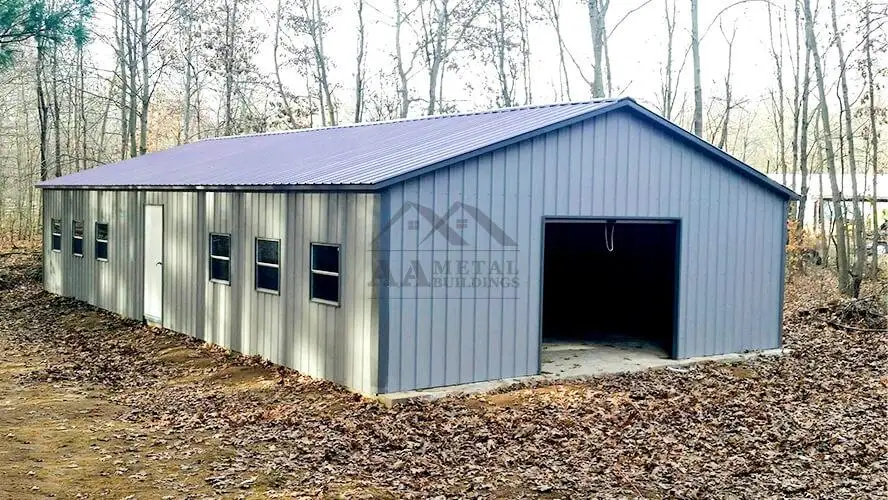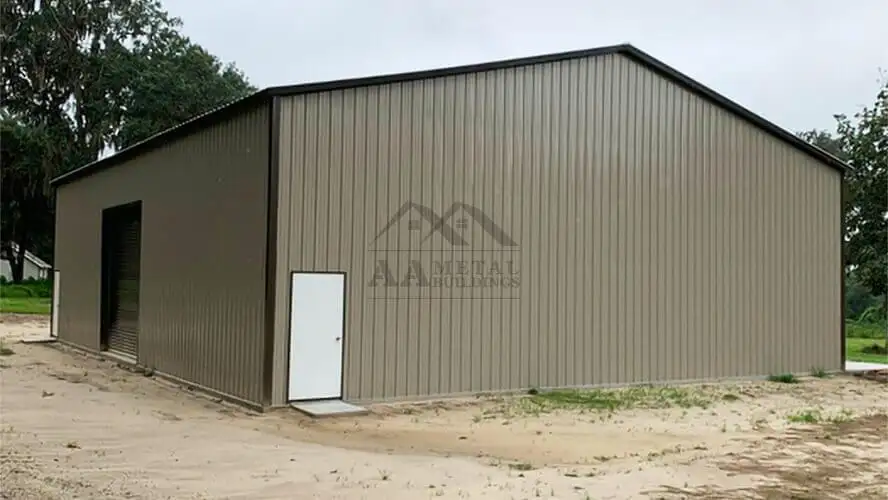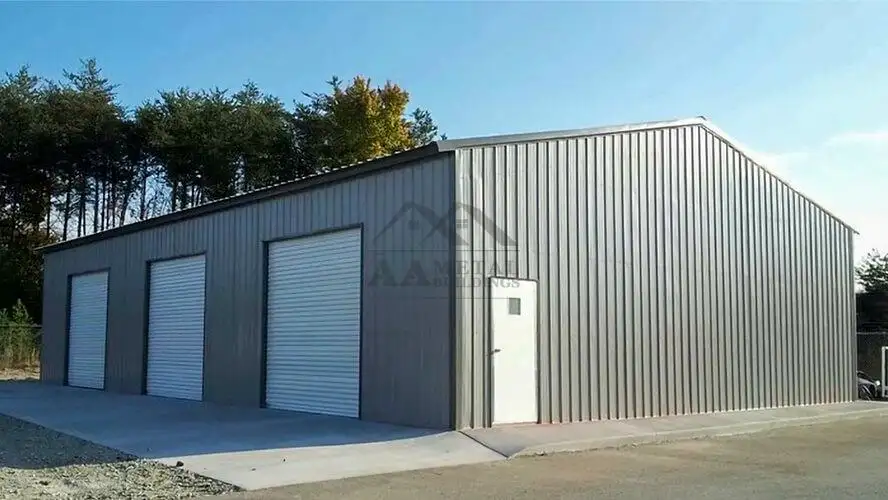
Buying a commercial steel building is one of the largest investments a business owner, contractor, or property developer will make. The price range is wide — a small commercial shop starts around $35,000 installed, while a large warehouse or industrial complex can exceed $200,000. What separates a smart purchase from an expensive mistake is knowing exactly what to ask, what to compare, and what’s actually included in the price before you sign anything.
This guide is written specifically for commercial buyers — business owners, contractors, developers, and property investors — who need a clear, honest breakdown of commercial steel building costs, sizes, uses, and the questions that separate a reputable supplier from one that will cost you more in the long run.
What This Guide Covers:
- Why do businesses choose steel over traditional construction?
- How much do commercial steel buildings cost in 2026?
- What sizes are available for commercial steel buildings?
- What are commercial steel buildings used for?
- What is included in a commercial steel building package?
- 8 questions to ask before buying a commercial steel building
- How does steel compare to traditional commercial construction?
- Frequently Asked Questions
Why Do Businesses Choose Steel Over Traditional Construction?
Commercial buyers choose pre-engineered steel buildings over wood-frame or concrete block construction for five primary reasons — and the gap between steel and traditional construction has widened in 2026 as conventional construction costs have continued climbing:
| Factor | Steel Building | Traditional Construction |
|---|---|---|
| Construction time | Days to weeks | Months |
| Cost per sq ft | $25–$55 installed | $150–$300+ installed |
| Annual maintenance | Near zero | Significant — painting, rot, pest |
| Interior columns | None — clear span | Load-bearing walls restrict layout |
| Expandability | Easy — add length at end walls | Complex and expensive |
| Lifespan | 50–60+ years | 25–40 years typical |
The clear-span interior — no interior columns breaking up the floor plan — is the single most commercially valuable feature of a pre-engineered steel building. Every square foot of your floor plan is usable. You place shelving, equipment, vehicles, and workstations where your operation needs them, not where structural columns allow.
How Much Do Commercial Steel Buildings Cost in 2026?
Commercial steel building prices in 2026 depend on four variables: size, enclosure level, wall height, and your location. Here is an honest price breakdown across the most common commercial building sizes at AA Metal Buildings:
What is the price of a commercial steel building by size?
| Building Size | Sq Footage | Shell Installed | Turnkey With Slab |
|---|---|---|---|
| 30×40 | 1,200 sq ft | $18,000 – $32,000 | $28,000 – $46,000 |
| 40×60 | 2,400 sq ft | $35,000 – $52,000 | $45,000 – $72,000 |
| 50×100 | 5,000 sq ft | $65,000 – $95,000 | $85,000 – $130,000 |
| 60×100 | 6,000 sq ft | $80,000 – $120,000 | $105,000 – $160,000 |
| 80×100+ | 8,000+ sq ft | $120,000 – $180,000+ | $160,000 – $250,000+ |
Prices include free delivery and professional installation. Final price depends on your ZIP code, wall height, roof style, enclosure level, and current steel market pricing. Call AA Metal Buildings for a real-time quote.
What is the cost per square foot for a commercial steel building?
Commercial steel buildings from AA Metal Buildings run approximately $25-$55 per square foot installed depending on size and finish level. Larger buildings benefit from economies of scale – a 50×100 costs significantly less per square foot than a 30×40 built to the same spec.
Cost Comparison: Traditional commercial construction typically runs $150-$300+ per square foot for the same usable footprint. A commercial steel building delivers equivalent or better structural performance at 20-30% of the cost.
Are commercial steel building prices going up or down in 2026?
Steel prices in 2026 have stabilized compared to the extreme volatility of 2021-2022 but remain elevated versus pre-pandemic levels. Current market conditions mean prices are unlikely to drop significantly in the near term — ordering sooner rather than later locks in current pricing before any further movement. AA Metal Buildings quotes are valid for a limited window due to steel market fluctuations — call us for a live price specific to your project.
What Sizes Are Available for Commercial Steel Buildings?
AA Metal Buildings offers commercial steel structures in any custom size — but these are the most commonly ordered commercial configurations and what each is best suited for:
| Size | Best Commercial Use | Recommended Wall Height |
|---|---|---|
| 30×40 | Small retail, contractor storage, auto repair | 12-14 ft |
| 40×60 | Workshop, equipment dealer, small warehouse | 14-16 ft |
| 50×100 | Distribution, manufacturing, commercial storage | 16-20 ft |
| 60×100 | Large warehouse, fleet storage, industrial | 18-24 ft |
| Custom | Any commercial application | Any height – call for specs |
Wall height matters more in commercial applications than residential. A 40×60 with 10 ft walls is a garage. The same 40×60 with 16 ft walls and three commercial overhead doors is a full-service auto shop or equipment dealer showroom. Always spec your wall height based on the tallest piece of equipment, vehicle, or racking system you plan to use inside.
What Are Commercial Steel Buildings Used For?
Auto repair shops and dealerships
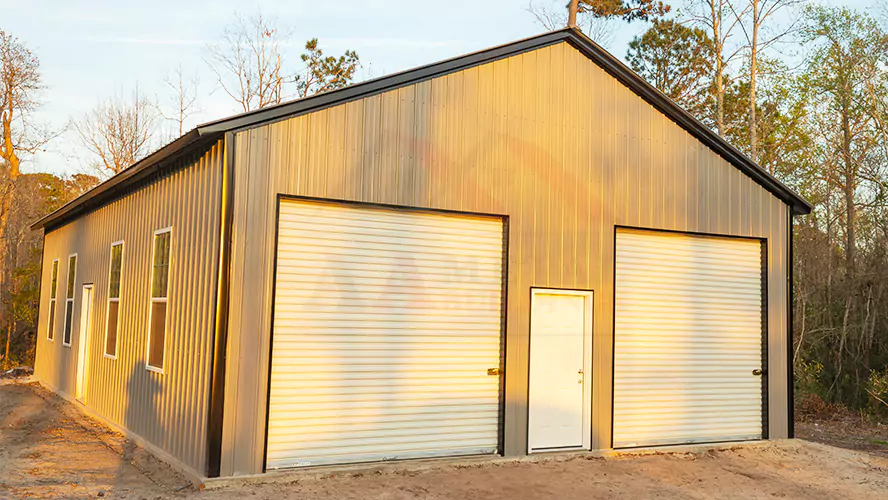
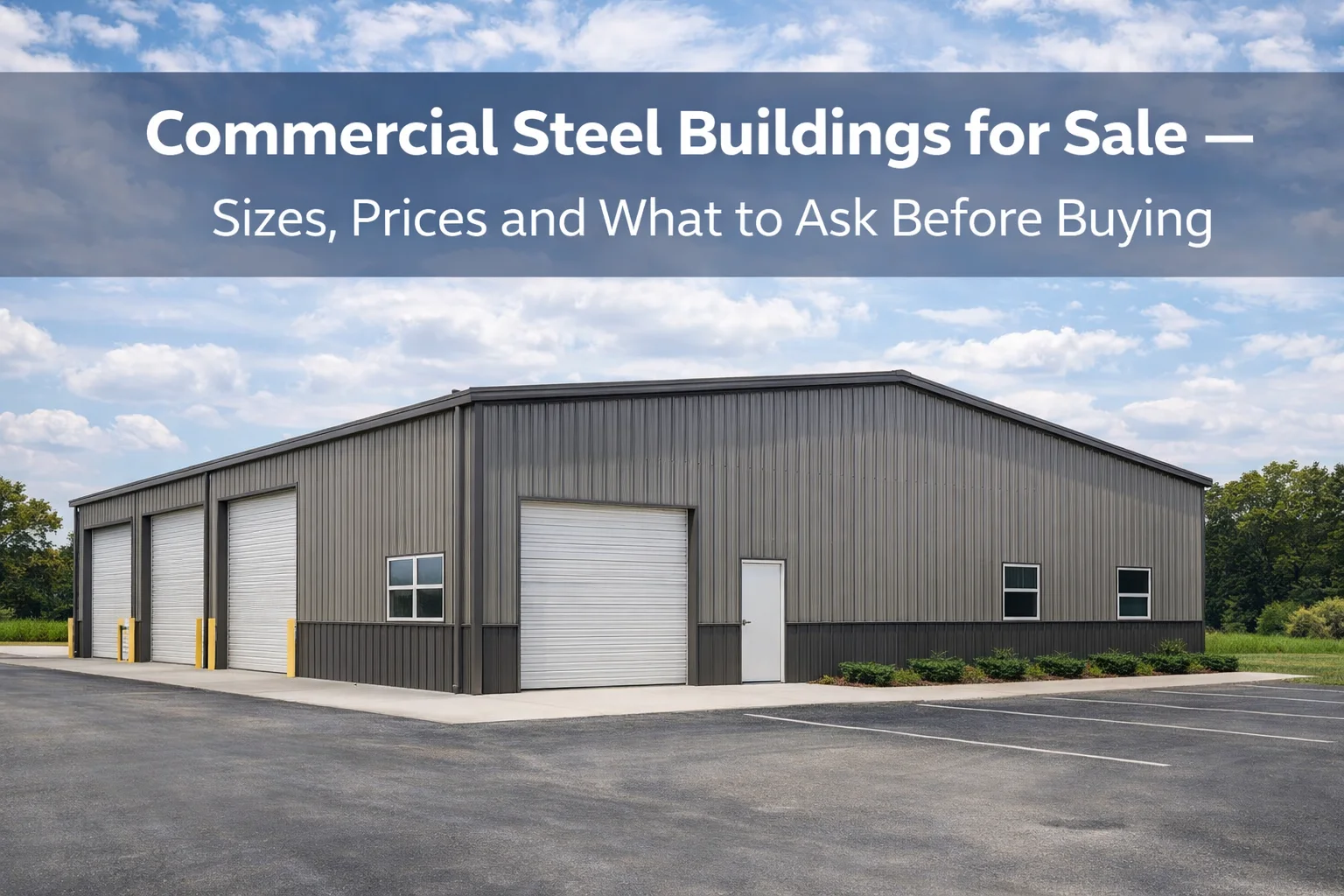
The most popular commercial steel building application. A 40×60 with 14-16 ft walls accommodates 4-6 vehicle bays with overhead doors on both end walls, a parts room partition, and a small office — all in clear-span space with no columns interfering with vehicle movement. The steel frame handles vehicle lifts, overhead hoists, and heavy equipment without the structural concerns of wood-frame construction.
Warehouses and distribution centers
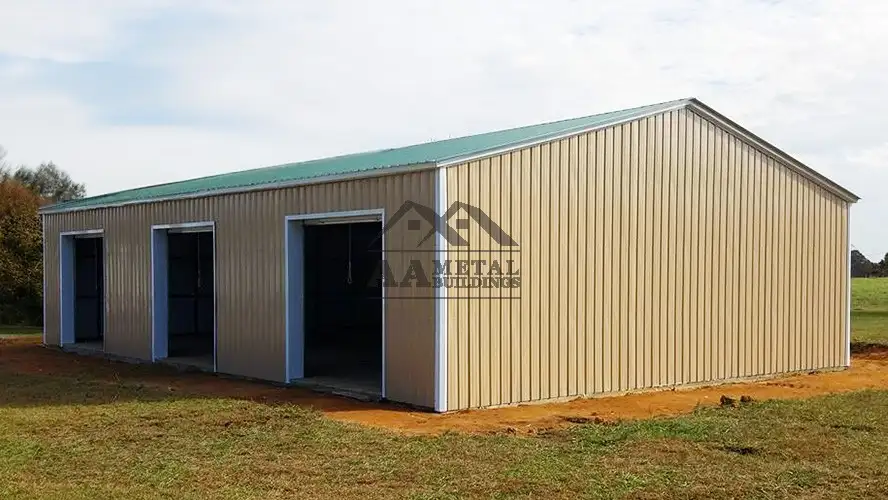
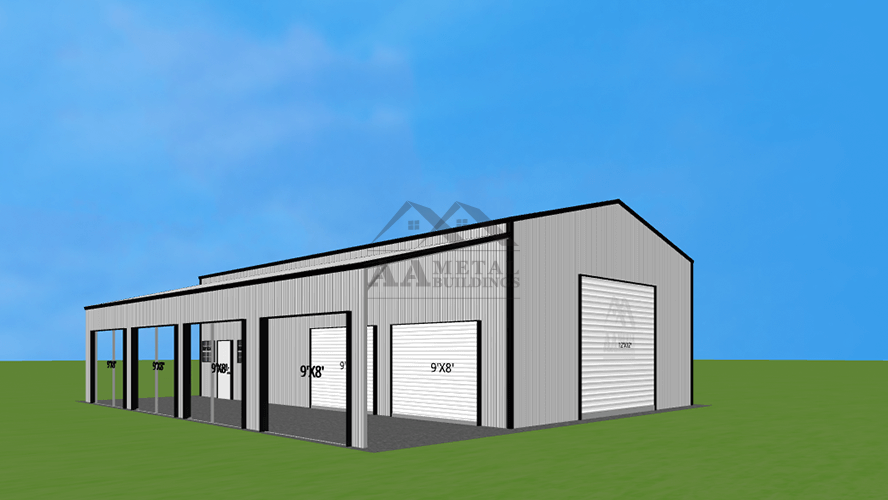
50×100 and larger commercial steel buildings are the standard choice for businesses that need bulk storage, receiving docks, and racking systems. The clear-span interior allows racking to be configured and reconfigured as inventory needs change — without working around structural columns. Lean-to additions can expand storage capacity at any time without a full rebuild.
Contractor and equipment storage yards
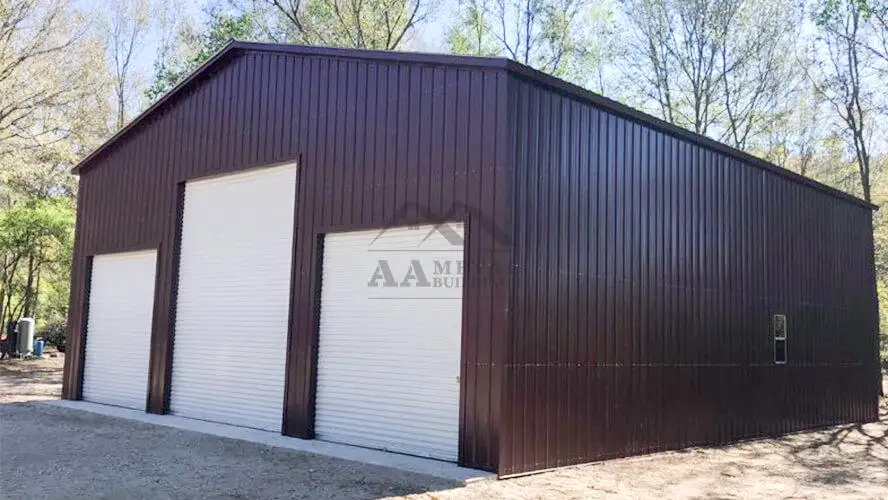
Landscapers, general contractors, electricians, plumbers, and equipment rental companies all use commercial steel buildings to secure vehicles, tools, and inventory overnight. A 40×60 with multiple roll-up doors and a vertical roof handles constant vehicle traffic and daily use better than any other structure type at this price point.
Retail and light commercial spaces
Steel buildings are increasingly used as retail storefronts, farm supply stores, feed stores, tire shops, and light commercial spaces — especially in rural and suburban markets where a 40×60 or 50×100 steel building is more cost-effective than leasing traditional retail space. With insulation, interior finishing, windows, and custom colors, a commercial steel building is visually indistinguishable from conventional construction.
Manufacturing and fabrication
Light manufacturing, metal fabrication, woodworking, printing, and assembly operations all benefit from the clear-span interior and the ease of running overhead cranes, dust collection systems, and electrical in a steel building. The non-combustible steel frame also reduces insurance costs versus wood construction for many manufacturing classifications.
Self-storage facilities
Multi-unit self-storage facilities are one of the fastest-growing commercial steel building applications. A 40×200 or 50×200 commercial steel building divided into individual storage units offers a scalable, low-maintenance income property that can be built and operational in weeks versus months for traditional masonry construction.
What Is Included in a Commercial Steel Building Package From AA Metal Buildings?
What is included in the base price:
- Primary steel I-beam frame — columns, rafters, and all structural connections
- Secondary framing — purlins, girts, and lateral bracing
- Roof and wall steel panels
- Complete trim package — ridge caps, corner trim, eave trim, base trim
- Standard door package — one roll-up door and one walk-in door
- All fasteners, sealants, and closures
- Certified PE-stamped engineering drawings
- Free delivery to your site
- Professional installation by our certified crew
What is not included in the base price:
- Concrete slab foundation — budget $8-$12 per sq ft depending on location
- Additional commercial overhead doors beyond standard package
- Insulation — strongly recommended for any conditioned commercial space
- Windows and personnel doors beyond standard package
- Interior partitions, offices, bathrooms, or mezzanines
- Electrical, plumbing, HVAC — contracted separately
- Local building permits — fees vary by county
Buyer’s Note: Always ask any commercial steel building supplier for a complete itemized quote. The most common source of budget overruns is a base price that excludes foundation, additional doors, and insulation — costs that can add $20,000-$50,000 to a large commercial project.
8 Questions to Ask Before Buying a Commercial Steel Building
1. Does the price include certified engineering drawings?
Most counties require PE-stamped drawings to issue a commercial building permit. Some suppliers charge separately for engineering — which can add $1,500-$5,000. At AA Metal Buildings, certified engineering drawings are included with every commercial order.
2. Is the building certified for my county’s wind and snow load requirements?
Commercial buildings face stricter code compliance than residential. Your county has specific wind load (MPH) and snow load (PSF) requirements your building must meet before a permit will be issued. Ask your supplier for the specific certifications in your quote and verify they match your county’s requirements before ordering.
3. What gauge steel is used in the frame and panels?
Commercial applications typically require 14-gauge steel framing as a minimum — 12-gauge for high-load applications. Wall and roof panels for commercial buildings are typically 26-gauge. Lighter gauge means lower upfront cost but reduced durability and lifespan. For a building that will see daily operational use for 20-40 years, the gauge of steel matters significantly.
4. What is the clear interior height at the eave?
The eave height — the measurement to the lowest point of the roof at the sidewall — limits the height of vehicles, equipment, and racking inside. A 14 ft eave height accommodates most commercial vehicles and standard racking. 16-20 ft allows overhead cranes, mezzanines, and tall equipment. Confirm this measurement before ordering — it is the single dimension that most affects commercial usability.
5. How many commercial overhead doors are included?
Most base quotes include one standard roll-up door. A commercial auto shop needs 4-6. A warehouse needs at least 2. Ask specifically how many commercial-grade overhead doors are included, what size they are, and the cost per additional door. Commercial overhead doors range from $1,200 for a basic 10×10 to $8,000+ for insulated high-cycle industrial doors.
6. Can the building be expanded in the future?
Most steel buildings can be extended in length by adding bays at end walls — sometimes years after original installation. Ask whether your specific design is expansion-ready and what adding 20, 40, or 60 feet of length would cost. Planning for future expansion at the design stage costs nothing. Retrofitting a building not designed for it costs significantly more.
7. What is the lead time from order to installation?
Commercial projects have hard timelines. Get a written lead time commitment — typically 4-8 weeks from order confirmation to installation start for commercial steel buildings in 2026. Build at least a 2-week buffer for permit approval and site preparation into your overall project timeline.
8. What warranty covers the frame, panels, and coating?
Ask for warranty documentation in writing before signing. Minimum to expect: a rust-through warranty on the structural frame and a paint/coating warranty on panels. Understand what voids the warranty — most require evidence of regular maintenance and prohibit certain modifications without approval.
How Does a Commercial Steel Building Compare to Traditional Commercial Construction?
| Factor | Commercial Steel Building | Concrete Block / Wood Frame |
|---|---|---|
| Cost per sq ft (installed) | $25-$55 | $150-$300+ |
| Time to occupancy | 6-12 weeks | 6-18 months |
| Interior columns | None — fully clear span | Load bearing walls limit layout |
| Annual maintenance | $50-$200 | $1,000-$5,000+ |
| Expandability | Easy — add bays at end walls | Extremely difficult and costly |
| Fire resistance | Non-combustible steel frame | Wood frame is combustible |
| Pest resistance | Immune to termites and rodents | Ongoing pest management required |
Frequently Asked Questions About Commercial Steel Buildings
How much does a commercial steel building cost in 2026?
Commercial steel buildings from AA Metal Buildings start at $18,000 installed for a small 30×40 shell and range up to $250,000+ for a large fully enclosed 80×100+ turnkey structure with foundation. Most commercial buyers in the 40×60 to 50×100 range spend $45,000-$130,000 all-in including slab and installation. Call AA Metal Buildings for a real-time quote based on your size, location, and specifications.
What is the most popular size for a commercial steel building?
The 40×60 (2,400 sq ft) is the most popular commercial steel building size — large enough for most auto shops, contractor operations, equipment dealers, and light warehouses, while remaining within a budget most small business owners can finance or self-fund. The 50×100 (5,000 sq ft) is the next most popular for businesses needing larger storage, distribution, or manufacturing space.
Do commercial steel buildings require a permit?
Yes — virtually all commercial steel buildings require a building permit. Commercial applications face stricter code compliance than residential, including wind load, snow load, and occupancy certifications. AA Metal Buildings provides certified PE-stamped engineering drawings with every commercial order — which is what most counties require to issue a commercial building permit.
How long does it take to build a commercial steel building?
From order confirmation to completed installation, most commercial steel buildings take 6-12 weeks total. This includes 4-8 weeks for manufacturing and delivery, plus 2-5 days for installation. Permitting, site preparation, and concrete slab curing add to the overall project timeline — plan for 8-16 weeks total from order to occupancy for most commercial projects.
Can a commercial steel building be insulated?
Yes — AA Metal Buildings offers complete insulation packages for commercial buildings including wall insulation, roof insulation, and door insulation. Insulation is strongly recommended for any commercial space that will be heated, cooled, or used for temperature-sensitive inventory. Proper insulation can reduce heating and cooling costs by 30-50% compared to an uninsulated structure.
Can I expand a commercial steel building after it is built?
Yes — most pre-engineered steel buildings can be extended in length by adding bays at one or both end walls, sometimes years after original installation. This is one of the most commercially valuable features of steel construction versus concrete or wood frame, which are extremely difficult and expensive to expand. Ask our team at the design stage whether your specific configuration is expansion-ready.
What is the difference between a commercial and residential steel building?
Commercial steel buildings are engineered to higher structural standards — heavier gauge steel, higher wind and snow load certifications, taller wall heights, larger door openings, and compliance with commercial occupancy codes. They are designed for daily operational use by multiple people and heavy equipment, versus the lighter-use demands of a residential garage or storage building.
Does AA Metal Buildings offer financing for commercial steel buildings?
Yes — AA Metal Buildings offers financing and rent-to-own options for commercial steel building purchases. Call our specialists to discuss payment structures that fit your business budget and timeline. Many commercial buyers also explore Section 179 tax deductions, which may allow the full cost of a commercial steel building to be deducted in the year of purchase — speak with your accountant about eligibility.
Ready to Price Your Commercial Steel Building?
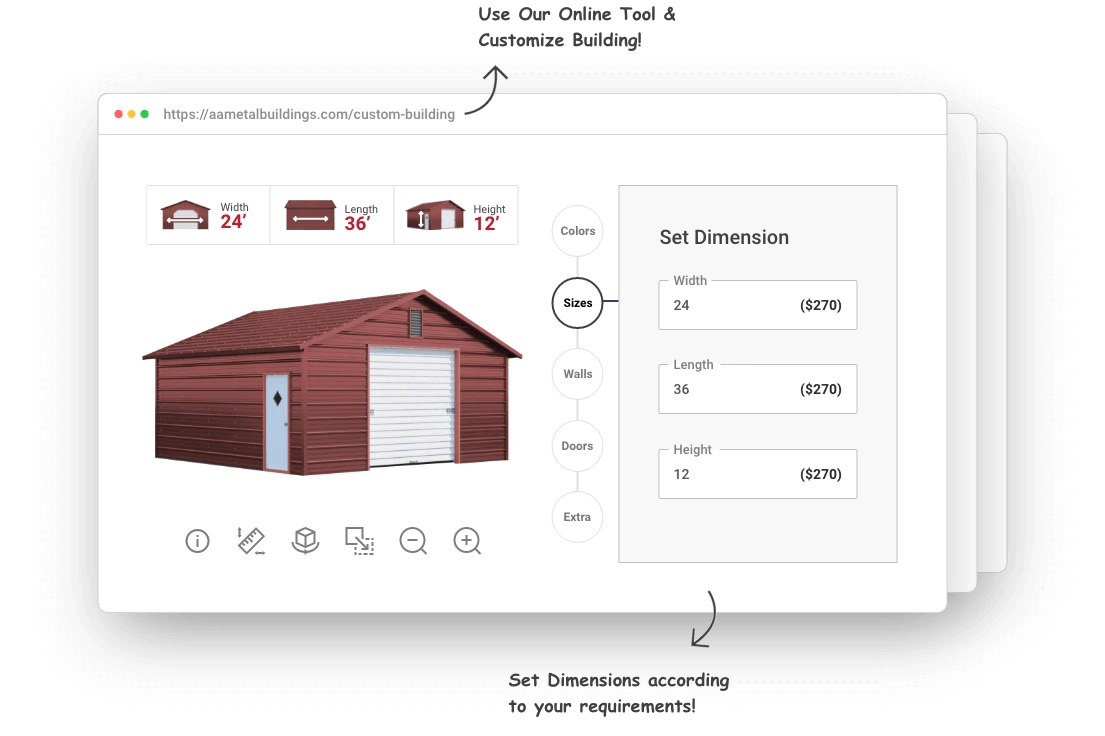
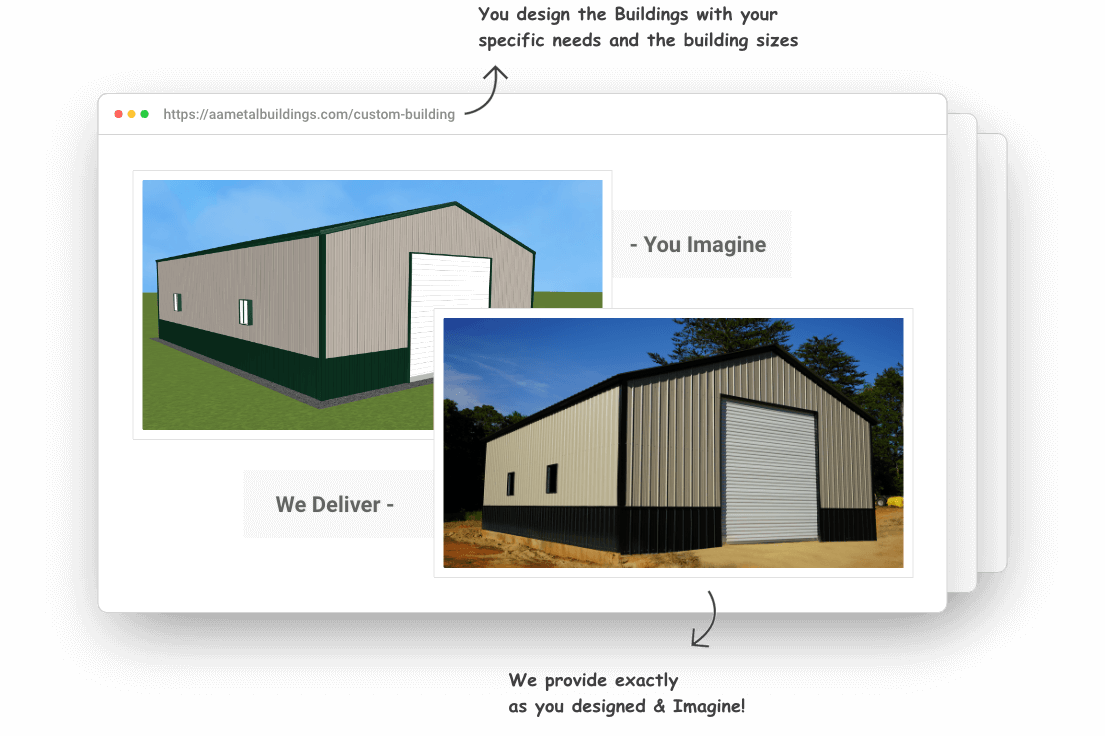
Our commercial building specialists understand business timelines, permit requirements, and operational needs. Call us today for a real-time, itemized quote for your commercial project — no obligation, no pressure, just accurate pricing for your ZIP code and specifications. Or use our free 3D Design Tool to configure and price your commercial building online right now.