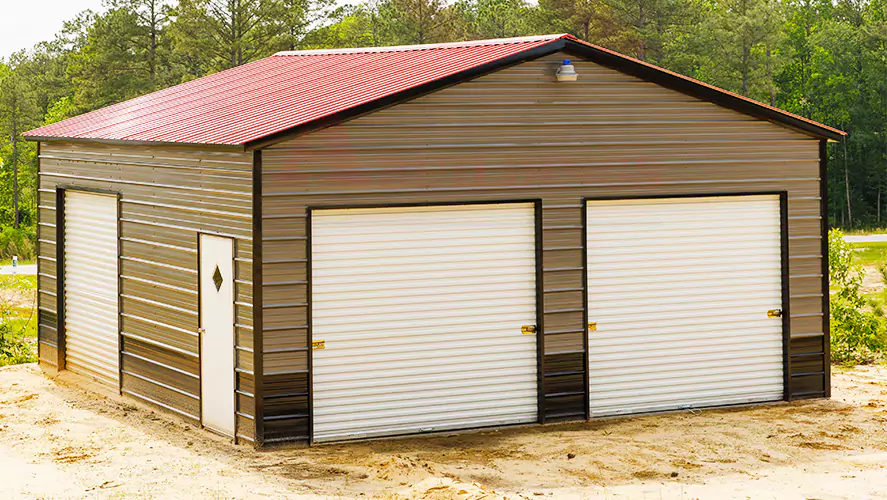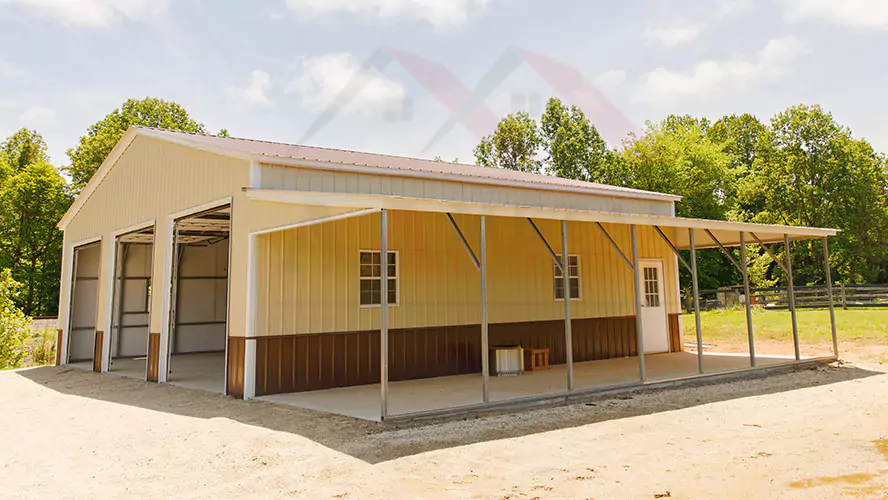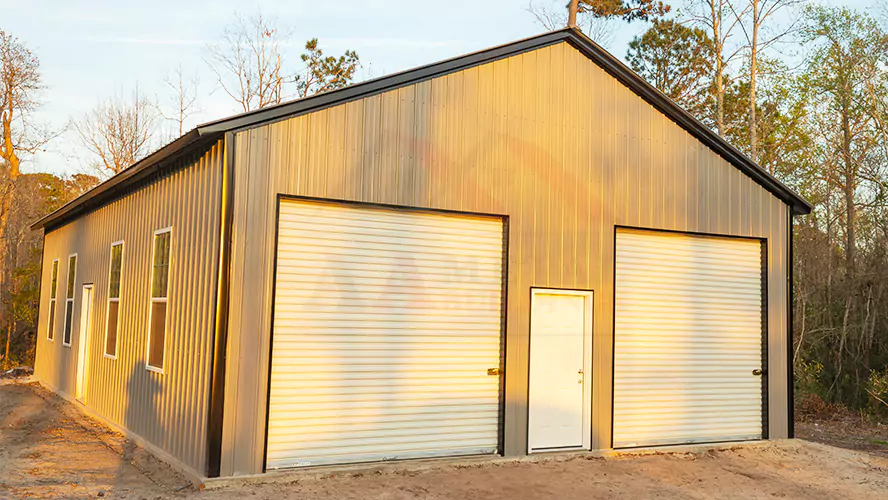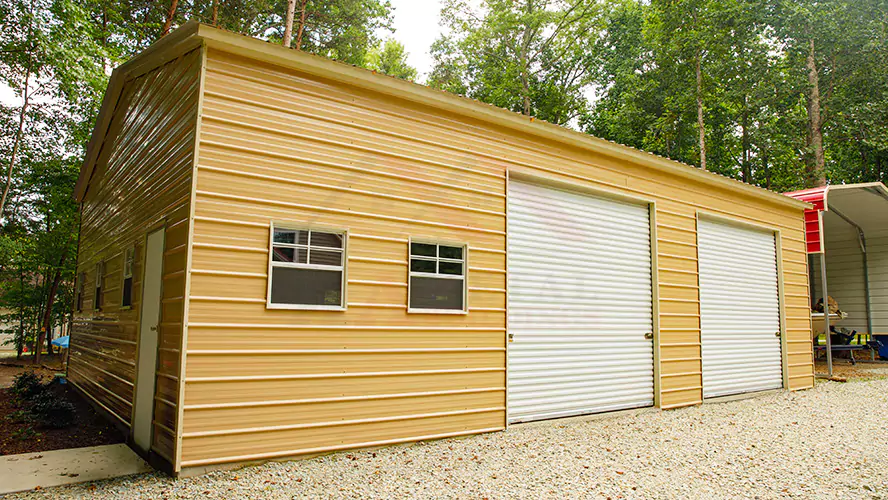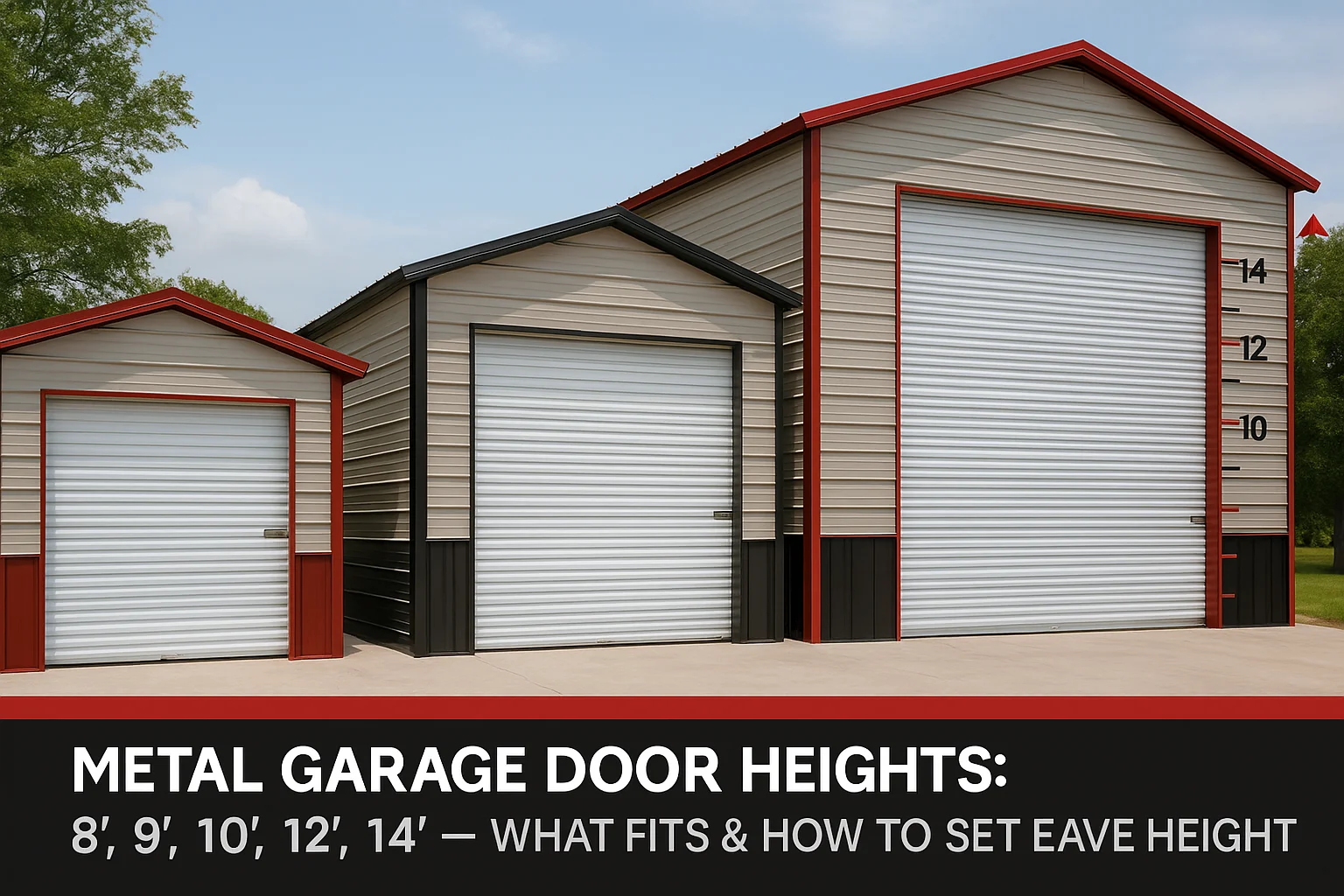
Picking the right door height sounds simple… until you’re staring at a fifth wheel, a lifted truck, and a quote you don’t want to redo. Door height is one of those choices you only want to make once. This guide shows what actually fits under 8′, 9′, 10′, 12′, and 14′ metal garage doors—with field notes from jobs we see every day.
Metal Garage Door Heights 101: Why the Size Actually Matters
On a metal building, door height = the clear opening at the door—not the total building height. That number drives three things:
- What you can park inside
- Total project cost (taller doors → taller eaves → more steel/bracing)
- Future-proofing (room for upgrades, new rigs, or racks)
Most folks size for what they own today. Regret shows up when they:
- Buy a taller camper
- Lift their truck
- Add a roof rack, ladder rack, or roof A/C
Rule of thumb: Measure the tallest point of your tallest rig, then add 12–18″ of buffer. That covers accessories, uneven approaches, and your nerves when backing in.
Plan the eave, not just the opening
Your eave height must exceed door height to fit hardware and framing.
- Sectional doors: allow ~12–15″ of headroom above the opening
- Roll-up/coiling doors: allow ~16–24″ above the opening for the coil hood (varies by width/wind rating)
It costs a bit more up front, but it’s cheaper than tearing out a too-short opening later.
What Fits Under an 8′ Metal Garage Door? (Everyday Vehicles)
Fits: cars & sedans, minivans, most crossovers/standard SUVs, many stock ½-ton pickups, small open trailers (most top out around 6′–7′).
Best for: typical suburban use; daily drivers; 1–2 car garages with no tall trailers.
Watch-outs:
- Factory roof racks/crossbars
- Small lifts/leveling kits
- Light bars or roof accessories
- Slope up into the garage reducing effective clearance
Bottom line (8′): Fine for cars/stock SUVs. If campers, taller enclosed trailers, or lifted trucks are in your future, 8′ is the bare minimum and likely short long-term.
What Fits Under a 9′ Metal Garage Door? (Extra Wiggle Room)
Fits: everything in 8′, plus most ½-ton & ¾-ton pickups (even mild lifts), taller SUVs with racks, small work vans, some enclosed utility trailers.
Best for: truck owners; small home shops; folks who want margin without going “RV tall.”
Limits: still tight for many enclosed cargo/travel trailers and most fifth wheels.
Bottom line (9′): Great comfort height for trucks and small trailers. Not true RV height.
What Fits Under a 10′ Metal Garage Door? (Entry-Level RV & Trailer Height)
Fits: Most pickups (moderate lifts), many small–mid travel trailers, lots of enclosed utility trailers, some cargo/work vans with racks.
Field note: Measure with the suspension loaded as parked (water/fuel/cargo) to capture true height.
Watch-outs: The highest point counts—roof A/C on campers, roof vents/antennas, oversize roof racks on vans/SUVs.
Bottom line (10′): Solid “entry-RV” height. Works for smaller campers and many enclosed trailers, but bigger RVs/fifth wheels usually need 12′+.
What Fits Under a 12′ Metal Garage Door? (Fifth Wheels & Bigger Trailers)
Fits: many fifth wheels, larger travel trailers & toy haulers, most goosenecks, medium tractors/skid steers (low attachments), taller ladder-rack work trucks.
Best for: serious campers; rural properties/hobby farms; small contractors with goosenecks.
Critical reality: many fifth wheels with rooftop A/C measure ~12′6″–13′3″. A 12′ opening can be marginal.
Bottom line (12′): Works for some fifth wheels and tall trailers, but if your measured height is ≥12′, step up to a 14′ door for real-world margin.
What Fits Under a 14′ Metal Garage Door? (Big RVs, Farm & Commercial)
Fits: Class A motorhomes, tall fifth wheels & big toy haulers, large goosenecks/equipment trailers, larger tractors/cab tractors, some box trucks.
Why 14′ matters: Many states cap vehicle height near 13′6″ on highways; a 14′ opening gives stress-free clearance for tall RVs/equipment.
Watch-outs:
- Higher eave/bracing cost
- Possible zoning/HOA height limits
- More surface area for wind (your engineering package accounts for it)
Bottom line (14′): Overkill for cars—perfect for big RVs/equipment and for anyone who never wants to think about clearance again.
Door Heights vs. Typical Uses (Quick Comparison)
| Door height | Typical uses | Common fits | Main limitation |
|---|---|---|---|
| 8′ | Standard residential | Cars, sedans, small SUVs, some stock ½-tons | Too short for most RVs/tall enclosed trailers; racks/lifts can bust it |
| 9′ | Upgraded residential / light shop | Most pickups (even mild lifts), taller SUVs, small work vans | Still tight for many enclosed cargo/travel trailers |
| 10′ | Entry RV / trailer storage | Small–mid travel trailers, many enclosed utility trailers, most pickups | Bigger RVs, fifth wheels, tall box trailers may exceed |
| 12′ | Serious RV / trailer & small farm | Some fifth wheels, larger travel trailers, many goosenecks, mid tractors | Many fifth wheels w/ A/C are 12′6″–13′+ → consider 14′ |
| 14′ | Big RV / farm / commercial | Class A RVs, tall toy haulers, big goosenecks, larger tractors, some box trucks | Higher eave/bracing cost; possible HOA/height limits |
Door Type Quick Note
Sectional vs. Roll-Up: Both deliver the specified clear opening height, but sectional doors need ~12–15″ of interior headroom for tracks, while roll-ups need ~16–24″ above the opening for the coil hood. This directly affects your required eave height and framing.
How to Choose the Right Garage Door Height (Step-by-Step)
1) Measure the tallest thing you own.
Park on level ground. Measure ground → highest point (RV roof A/C, roof rack/cargo box, light bar/antenna, top of tractor cab). Measure with the suspension loaded (typical water/fuel/cargo).
2) Add 12–18 inches of clearance.
~12″ buffer for smaller rigs; ~18″ for expensive RVs/tall equipment. Buffers cover approach slope and seasonal threshold buildup.
3) Think 5–10 years ahead.
Upgrading to a taller camper? Considering a lift kit? Growing a business needing taller vans/trailers? If growth is likely, choose the taller door now.
4) Check local limits.
HOA rules and city/county zoning for accessory structures and door/eave/peak height caps. Your designer can fit door height within allowable eave/peak.
5) Match door height to building height properly.
Ask for required headroom (sectional vs roll-up). Set eave height = door height + required headroom + framing margin. Confirm roof pitch and any interior bracing near the opening.
Hidden Clearance Killers (People Forget These)
- Door hardware & openers: Tracks, torsion bars, and motors hang down—design for them.
- Interior framing/bracing: Bottom chords or braces can be lower than eave height.
- Driveway slope/ramps: Approach angle reduces effective clearance at the header.
- Slab thickness & floor build-up: Thicker slabs and future coatings (epoxy/tile/mats) can shave ¼–½″ off opening height.
What to tell your supplier (up front):
- What you’re storing (truck, fifth wheel, tractor, etc.)
- Exact measured height at the highest point
- Any plans to upgrade to something taller
- Driveway is flat, sloped, or TBD
The more you share, the fewer surprises.
Ready to Plan Your Metal Garage?
If you’re between 10′, 12′, or 14′, you’re not alone—most people underestimate height. That’s where an expert helps.
AA Metal Buildings can help you measure, pick the right door height, set the correct eave, and price a steel garage that actually fits your trucks, trailers, or RV—from design to installation, start to finish.