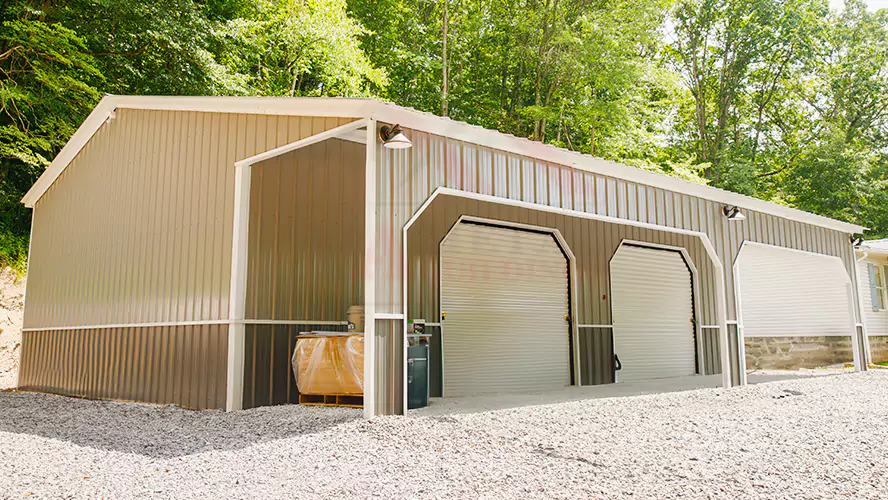
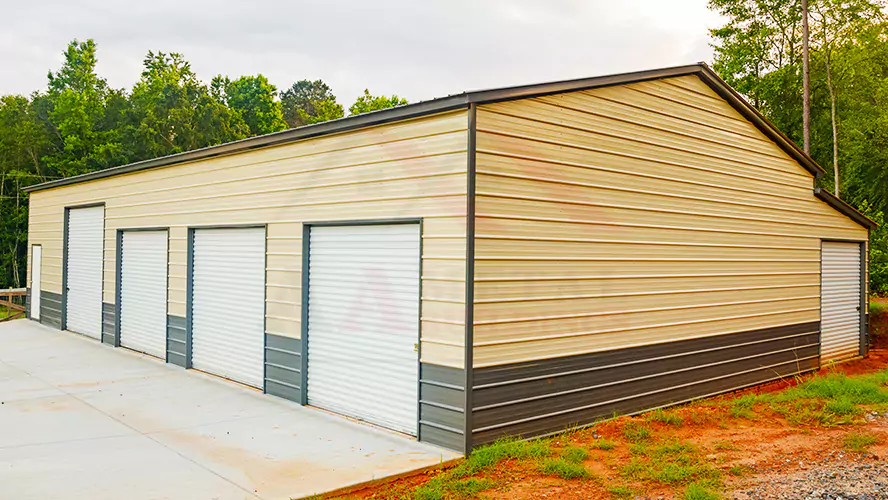
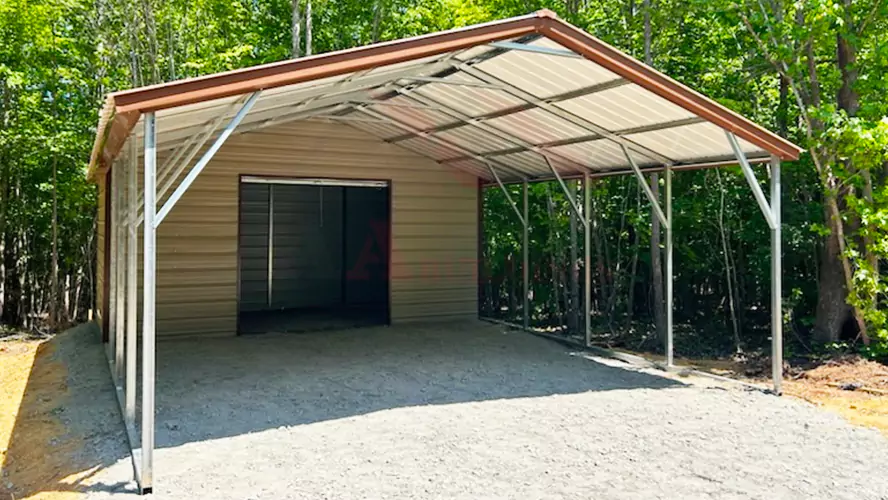
Most metal garage headaches don’t start with the steel package. They start under your boots. I’ve seen folks spend good money on a sharp-looking building, then spend the next year fighting sticky doors, muddy corners, and water sneaking in under the base trim because the “foundation” was basically whatever the dozer left behind. The fix isn’t fancy. It’s picking the right base for your site, then building it like you mean it. Slab, gravel, or piers can all work. The wrong one for your soil and weather will make you hate your garage, even if the building itself is built right.
A metal garage foundation is what keeps the building sitting right—level, anchored, and dry. Most garages use one of three bases: a concrete slab, a compacted gravel pad, or concrete piers. Slabs cost more but give you a real floor and easier door alignment. Gravel is cheaper and drains well if it’s built deep, compacted, and separated with fabric when needed. Piers fit slopes and weak soils, but must match frost depth and engineered spacing.
Here’s what you really need to decide
- Where water goes after a hard rain
- Frost depth (or if you never freeze)
- What’s going inside: daily driver, full-size truck, lift, mower, pallets
- Door height + driveway slope (clearance surprises people)
- Wind/snow rating on your drawings
- Soil type: clay, sand, fill, or rock
- How flat the floor needs to be (lifts and rolling toolboxes are picky)
The three foundations (and when they actually make sense)
Start with water and dirt (the part nobody wants to pay for)
Before you pick slab vs gravel vs piers, look at two things.
Where water goes
If you can, go look at the spot after a good rain. That’s when the site tells on itself. If you can’t be there during a storm, you can still read the signs: low areas that stay darker, a little line of leaves and sticks where water “parks,” ground that feels squishy, or a ditch nearby that looks like it overflows. You can do everything right with the foundation and still hate the garage if water keeps getting funneled straight at the overhead door.
What the soil does when it’s wet
Clay expands, shrinks, and turns slick. Sand drains better but can shift if it’s loose. Fill dirt is the wild card—sometimes it’s great, sometimes it settles for a year straight. If you don’t know what you’re on, dig a quick test hole. If you hit black topsoil and roots, that has to go. It’s not a base. It’s compost.
Most folks don’t notice door-area grading until install day. The crew steps back and realizes the driveway slopes toward the opening like a waterslide. That’s when you hear, “Can we just raise the building?” Sure… if you like redoing everything tied to that elevation.
Option 1: Concrete slab (best “real garage” setup)
If you want a true garage—clean floor, easy sweep, solid anchoring, and doors that behave—slab is usually the winner.
Slab thickness (what I see work)
- 4″ works for normal cars and light shop use when the base is solid.
- 5″–6″ starts making sense for heavier trucks, frequent jack stands, UTVs, or if you’re hard on the floor.
- For a 2-post lift, you’re often into 6″ or an engineered thickened area. Don’t guess. Follow the lift spec and your plans.
Concrete strength, reinforcement, and control joints
Most garage slabs land around 3,000–4,000 PSI concrete mix depending on local practice and exposure (freeze/thaw, deicers, etc.). Reinforcement varies: wire mesh, rebar, fiber, or a combo—your engineered drawings should call it out.
Control joints matter too. Concrete cracks. The goal is making it crack where you planned, not wherever it feels like. That’s why saw cuts or tooled joints show up in a grid.
Base under the slab (this is where slabs win or lose)
Concrete doesn’t magically fix bad dirt. If the subgrade is soft, the slab will crack or settle and you’ll blame the concrete guy for something that started with the excavator. On our jobs we want firm soil, then a compacted stone base so water doesn’t sit under the slab. Before we pour, we’ll shoot it with a laser and check square corner-to-corner. If it’s out of level or out of square now, it won’t get better once it’s hard.
Vapor barrier (especially if you’ll actually use the garage)
If you want the shop to feel dry, don’t skip the vapor barrier. Without it, moisture comes up through the slab and you’ll notice it first on anything metal—toolboxes, table saw tops, that kind of stuff. And if you ever want epoxy, it’s the difference between “looks great” and “peeling in sheets.” A thicker poly barrier with taped seams is cheap insurance compared to fixing moisture problems later.
Door alignment and base trim (why slabs feel “easy” later)
Metal buildings love square. Doors love square even more. A slab gives you a consistent plane to anchor to, and that usually means fewer “the door rubs on the latch side” calls down the road.
One mistake I see a lot: setting the slab too low. If your outside grade ends up higher than your slab later (after gravel, driveway, landscaping), you’ve basically built a bathtub lip. Water wants to sit at the base trim.
Small contractor anecdote (because I’ve watched it happen)
We did a 30×40 shop where the owner wanted to save money and skipped the thicker edge detail the plan recommended. Looked fine day one. First winter, the outside edge caught freeze/thaw and settled just enough that both overhead doors started dragging. We ended up cutting and re-pouring the door apron area. Doors are always the first thing to rat you out when the foundation isn’t happy.
Option 2: Compacted gravel pad (cheap can be smart… or dumb)
A gravel pad can be a solid foundation if you build it like a foundation, not like a driveway patch.
Where gravel shines
- Storage garages where you’re not rolling toolboxes around all day
- Equipment parking that doesn’t need a spotless floor
- Fast installs when you want to build now and maybe pour a slab later
- Wet sites where drainage is the whole game
Where gravel becomes a pain
- Daily-driver garages (mud gets tracked in, then it lives there)
- Any shop where you want a jack to roll smoothly
- Cold climates where frost heave is real and the base isn’t built thick enough
What “good gravel” actually is
You want angular crushed stone that locks together. Round river rock doesn’t compact the same way—it rolls and shifts. Most pads use a well-graded crushed stone product (your local yard name varies), placed in lifts and compacted.
If your soil is soft, geotextile fabric underneath is worth it. It keeps the stone from disappearing into the dirt over time.
Compaction isn’t optional. A skid steer driving back and forth isn’t compaction. A plate compactor, jumping jack, or roller is compaction. If you can twist your boot and leave a rut, you’re not done.
Gravel pad + anchoring (don’t wing this)
A lot of metal buildings on gravel use engineered ground anchors or specific anchor systems tied to wind uplift requirements. Your wind exposure and building height matter here. If your building package is engineered, follow the anchor plan.
Option 3: Concrete piers (best for slopes, bad soil, and wet ground)
Piers get misunderstood. People hear “piers” and think “cheap.” On a flat, easy lot, piers can cost more than gravel because layout and concrete work add up. Where piers are excellent is when the site is fighting you.
Piers make sense when
- You’ve got a slope and don’t want to haul out a mountain of dirt
- The ground stays wet and you want the building up off the mud
- Soil is questionable and you’d rather hit good bearing deeper down
- You’re in a humid area and want airflow underneath
Pier basics (what needs to be right)
Piers are usually formed with tubes (commonly 12″–24″ diameter, depending on loads) and tied into brackets or embeds that connect to the frame. Spacing isn’t random. It’s based on the building’s load path—columns, frames, and uplift points.
If you’re in freeze/thaw country, pier bottoms typically need to be below frost depth to avoid heave. If you’re not sure, your local building department and stamped drawings decide it.
The everyday annoyance nobody plans for: the perimeter
Piers lift the building, which means you’ve got “under-building” space to manage. If you don’t plan the perimeter (skirting, grade beam, rat wall—whatever your design calls for), you’ll end up feeding critters and chasing leaves every windy week. Not a dealbreaker. Just plan it before the holes get drilled.
Option | Cost | Best For
| Option | Cost (installed, typical ranges) | Best For |
|---|---|---|
| Concrete slab | $6–$12 / sq ft | Daily parking, workshops, clean storage, easiest doors |
| Compacted gravel pad | $1–$3 / sq ft (more on rough sites) | Storage garages, budget builds, drainage-heavy sites |
| Concrete piers / pier-and-beam style | $6–$15 / sq ft equivalent (varies a lot) | Slopes, poor soils, wet areas, minimal excavation |
Foundation | Minimum Prep | Notes
| Foundation | Minimum Prep | Notes |
|---|---|---|
| Slab | Strip organics + compacted base | Best floor, easiest door alignment |
| Gravel pad | Strip topsoil + fabric (often) + compacted lifts | Drains well, can rut if thin or underbuilt |
| Piers | Layout + proper depth + engineered spacing | Great on slopes/wet ground, perimeter needs a plan |
Doors, clearance, and access (where foundation mistakes show up first)
Even though this is a foundation guide, doors and vehicles matter because a foundation that moves shows up at openings first.
Common overhead door sizes (real-world picks)
- 8′ x 7′: small cars, tight with mirrors
- 9′ x 7′: nicer everyday door for cars and small SUVs
- 10′ x 8′: good for full-size pickups, roof racks, taller tires
- 12′ x 10′ and up: trailers, RV doors, big equipment
A full-size pickup is often 19–22 feet long and roughly 80 inches wide before mirrors. Mirrors and door swing eat space fast, especially if you’re parking next to shelving.
- Slab gives you a clean approach and consistent threshold.
- Gravel can rut at the entrance if it’s thin or poorly compacted.
- Piers often need a planned apron/ramp so you’re not bumping up into a step every day.
Roof style can matter here as well. Gable roofs shed snow differently than single-slope roofs, and drifting can load one side heavier depending on wind. In snow country, that affects your engineering and sometimes your foundation/anchor details.
Here’s what usually goes wrong (and how to dodge it)
Doors won’t close cleanly after a season
That’s usually settlement or the building went a hair out-of-square. Slabs help when the base is right. Gravel and piers can work too, but compaction and layout have to be tight. Measure diagonals, check square, and don’t rush anchor placement.
Water runs in under the overhead door
That’s grading and drainage, not “bad metal.” Fix the outside: slope away, cut a swale, add gutters, extend downspouts away from corners. If you’re pouring a slab, set finished floor height with runoff in mind from day one.
Slab feels damp or “sweats”
Usually vapor barrier got skipped or torn up, or water is trapped under the slab. It’s annoying, and it shows up fast when you start storing tools and cardboard. If you want a dry shop, treat moisture like a real design item, not an accessory.
Gravel pad turns into ruts
Thin stone, wrong stone, no fabric, poor compaction, or soft subgrade. Fix is usually adding more base and compacting correctly—sometimes with fabric after you rework the subgrade.
Anchors loosen or pull
Wrong anchor type, wrong embedment, or the foundation wasn’t built for the building loads. Wind uplift hits corners and endwalls hard. Your engineered drawings and local inspector win if there’s a conflict—follow them.
Quick picks (no overthinking)
- Want a real shop floor? Slab.
- Want the cheapest base for storage? Gravel pad, built right.
- Fighting a slope or wet ground? Piers, engineered.
FAQs (real search queries)
How much does a 24×24 concrete slab cost for a metal garage?
A 24×24 slab is 576 sq ft. Using a common installed range of $6–$12 per sq ft, you’re roughly $3,500–$7,000. Extras can push it up: thicker edges, higher PSI mix, pump fees, tough access, bad soil, or drainage work. The site and the concrete crew schedule matter as much as the math.
Do I need rebar in a metal garage slab?
Often, yes—either rebar, mesh, fiber, or a combo depending on the plans and soil. Light use can get by with simpler reinforcement if the base is solid. Heavy use (trucks, lifts, frequent jack stands) should follow the engineered spec. The big failure I see is reinforcement sitting on the ground instead of being supported in the slab where it actually helps.
What size gravel base should I use under a metal garage?
A lot of garages do well with 4″–8″ of compacted crushed stone over firm subgrade. Soft clay, bad fill, or heavy trucks usually mean thicker. Fabric under the stone helps when the soil is weak. Thin gravel over topsoil looks okay for a month, then turns into ruts and puddles.
How do I prep ground for a gravel pad metal garage?
Strip topsoil, shape the subgrade so water leaves, then lay geotextile fabric if the soil is soft. Bring in angular crushed stone, place it in lifts, and compact each lift. Don’t just spread it and call it good. Build the pad slightly above surrounding grade so water isn’t trying to live at your base trim.
Do I need a vapor barrier under a metal garage slab?
If you want a dry interior, yes. Moisture moves up through concrete. A vapor barrier with overlapped, taped seams helps stop that damp slab feeling and protects coatings like epoxy. If you’re planning insulation or radiant heat later, you’ll be glad you handled moisture correctly upfront.
How do I anchor a metal building to a concrete slab?
Most use wedge anchors, epoxy anchors, or embedded hardware based on the engineered drawings. Anchor spacing and embedment aren’t “builder preference”—they’re tied to uplift and shear loads from your wind/snow rating. Match the plans, keep the layout square, and don’t substitute hardware because it was cheaper at the store.
Can a metal garage sit on piers instead of a slab?
Yep—piers work fine if the building is designed for them. They’re a great fix for sloped lots or soggy ground because you can get down to solid bearing without massive excavation. The details matter: pier spacing has to match frame loads, bottoms need to hit frost depth where required, and you may need a grade beam or perimeter beam. Plan the perimeter too so critters and windblown debris don’t become your new hobby.
What size garage fits a full-size truck comfortably?
For one full-size pickup with room to walk around and still have a bench, 20′ wide x 24′ deep starts feeling comfortable. Two trucks? 24’×24′ is a common minimum that doesn’t feel like a daily squeeze. Door openings matter a lot—10′ wide doors make parking less stressful than 8′ doors, especially if you back in.
How much does a gravel pad cost per square foot?
On an easy site with decent soil and good access, gravel pads often land around $1–$3 per sq ft. Once you start doing real prep—stripping topsoil, hauling spoils, adding fabric, going thicker with crushed stone, cutting drainage, building up low areas—that number climbs. The stone isn’t usually the killer. It’s machine time and trucking, especially with tight access.
If you want help planning this the right way, the team at AA Metal Buildings can walk you through layouts and options without making it complicated.