You’ve done everything right. You called two steel building suppliers, gave them the exact same size, the same roof style, the same location. And somehow the quotes came back thousands of dollars apart. Now you don’t know which one to trust, whether the cheaper one is cutting corners, or whether the expensive one is padding margins.
This happens to almost every steel building buyer — and it’s almost never because someone is being dishonest. It’s because two suppliers can quote the same building size and be describing completely different things. This guide explains exactly why quotes differ, what each line item actually means, and how to compare any two quotes fairly before you commit to either one.
What This Guide Covers:
- Why do two steel building quotes for the same size come back so different?
- What are the three types of steel building quotes?
- What actually moves the price between two quotes?
- How does the steel market affect the quote you receive today?
- How to compare two steel building quotes line by line
- What are the red flags in a steel building quote?
- How AA Metal Buildings quotes are structured
- Frequently Asked Questions
Two Steel Building Quotes for the Same Size Come Back So Different
The short answer: because “same size” is the only thing the two quotes actually have in common. Everything else — what’s included, the steel gauge, the engineering specs, the roof style, whether delivery and installation are in the number — can be completely different between two suppliers quoting the same footprint.
Here is a real-world example of how two quotes for a 40×60 metal building can differ by $15,000 or more while describing the same square footage:
| Line Item | Supplier A Quote | Supplier B Quote |
|---|---|---|
| Base price shown | $28,000 | $41,000 |
| What’s included | Kit only — frame + panels | Kit + delivery + installation |
| Steel gauge | 26-gauge panels, lighter frame | 14-gauge frame, 26-gauge panels |
| Engineering drawings | Not included — extra $2,500 | Included |
| Delivery | Not included — extra $1,800 | Included |
| Installation | Not included — extra $6,000 | Included |
| True total cost | $38,300 | $41,000 |
| Actual difference | Only $2,700 — not $13,000 as the headline prices suggested | |
This is the most common quote comparison trap in the steel building industry. A buyer sees a $28,000 quote next to a $41,000 quote and assumes the cheaper supplier is the better deal — without realizing the cheaper quote doesn’t include delivery, installation, or engineering drawings that the other one does. By the time the add-ons are applied, the prices are nearly identical — or the cheaper quote has become the more expensive one.
The rule: Never compare headline prices. Always compare total delivered, installed cost for an identical scope of work. Everything else is a marketing number, not a real price.
What Are the Three Types of Steel Building Quotes?
Before you can compare any two quotes fairly, you need to know which type of quote each one is. There are three — and they are not interchangeable:
Type 1 — Kit-only quote
This covers the manufactured steel package only: the frame, panels, fasteners, and trim. It does not include delivery to your site, installation labor, foundation, permits, or engineering drawings. Kit-only pricing is the most common source of “starting at” prices you see advertised online. It is the lowest number — and it represents the smallest portion of your total project cost.
Who this works for: Experienced owner-builders who will self-erect the building and already have their own delivery and site prep arranged.
Type 2 — Installed shell quote
This covers the kit plus delivery and professional installation. It does not include the concrete slab foundation, interior finishing, electrical, or plumbing. This is the most apples-to-apples number for most buyers who want the building up and weather-tight but will handle the foundation and interior separately.
Who this works for: Most residential and agricultural buyers who already have a site prepared or are arranging their own foundation work.
Type 3 — Turnkey quote
This covers everything: kit, delivery, installation, and concrete slab foundation. Sometimes it also includes engineering drawings, permits processing assistance, and insulation. This is the true all-in cost of a steel building project and the only number that makes sense to compare between suppliers when you want a fully functional building with nothing left to coordinate yourself.
Who this works for: Commercial buyers, time-constrained projects, and anyone who wants one vendor responsible for the complete project.
The fix: Before comparing any two quotes, call both suppliers and ask: “Is this a kit-only price, an installed shell price, or a full turnkey price including foundation?” If you get different answers, you are not comparing the same thing — and the number comparison is meaningless until you normalize them.
What Actually Moves the Price Between Two Steel Building Quotes?
Once you’ve confirmed both quotes cover the same scope, here are the legitimate variables that cause real price differences between two suppliers quoting the same building:
Steel gauge — the single biggest quality variable
Steel gauge describes the thickness of the steel used in the frame and panels. Lower gauge numbers mean thicker, stronger steel. Here’s what the common gauges mean in practice:
| Component | Standard Gauge | Heavy-Duty Gauge | Price Impact |
|---|---|---|---|
| Frame (columns + rafters) | 14-gauge | 12-gauge | +8-15% on kit price |
| Roof and wall panels | 26-gauge | 24-gauge | +5-10% on kit price |
| Secondary framing (purlins) | 14-gauge | 12-gauge | +3-6% on kit price |
A supplier who quotes a lighter-gauge frame will always have a lower price — but the building will have a lower wind and snow load rating, shorter lifespan, and in some counties will not pass the engineering certification required for a permit. Always ask: “What gauge is the frame and what are the wall and roof panels?”
Wind and snow load certification
Your county has specific minimum wind load (in MPH) and snow load (in PSF) requirements that any structure must meet to receive a building permit. A supplier who engineers your building to the minimum county requirement will quote less than one who builds in a safety margin above the minimum. Both meet code — but one will perform better in a 10-year storm event than the other. Ask each supplier: “What wind load and snow load is this building certified to, and does that meet or exceed my county’s requirements?”
Roof style
Three roof styles at three price points — and they are not equivalent in performance:
- Regular roof — lowest price, horizontal panels, rounded edges. Best for mild climates with low rain and snow.
- Boxed eave — mid-range, A-frame shape, cleaner look. Good for most US climates.
- Vertical roof — highest price, panels run ridge to eave, superior water and snow shedding. Recommended for any state with significant rainfall or snowfall.
A quote for a regular roof on a 40×60 can be $2,000-$4,000 less than a vertical roof quote for the same building. If one supplier quoted you a regular roof and the other quoted vertical, you are not comparing equivalent structures.
Wall height
Standard eave height is 10 feet. Every additional foot of wall height adds steel to the columns, changes the panel lengths, and increases the price. A 40×60 with 10 ft walls vs a 40×60 with 14 ft walls are genuinely different buildings at different price points — even though the footprint is identical. Confirm the eave height in every quote.
Number and size of doors included
Most base quotes include one standard roll-up door and one walk-in door. Additional doors — especially commercial-sized overhead doors — add significantly to the price. If you told both suppliers you need three 10×10 roll-up doors and one quote includes them while the other only includes the standard one-door package, the price difference is the doors — not a quality difference between the suppliers.
Delivery distance
Steel buildings are heavy and require specialized transport. Delivery costs vary by distance from the manufacturing facility to your site. Two suppliers with different manufacturing locations will quote meaningfully different delivery costs for the same building going to the same site. This is a legitimate price difference that has nothing to do with building quality.
How Does the Steel Market Affect the Quote You Receive Today?
Steel is a globally traded commodity — and its price fluctuates based on factors that have nothing to do with your building project. Understanding this protects you from two common buyer mistakes: waiting for prices to drop, and being surprised when a quote expires.
Why does a steel building quote expire so quickly?
Most steel building quotes are valid for 7-14 days. This is not a sales tactic — it is a direct reflection of steel market volatility. The building kit typically represents 40-50% of the total project cost, and steel is the largest material component within that kit. When hot-rolled coil steel prices move at the mill level, manufacturers adjust kit pricing within weeks. A quote held open for 30 days at a fixed price exposes the supplier to real financial risk if steel prices spike in the interim.
Should I wait for steel prices to drop before ordering?
Based on current 2026 market conditions — probably not. Steel prices have stabilized from the extreme volatility of 2021-2022 but remain at roughly double pre-pandemic levels. Industry surveys from early 2026 show approximately 54% of steel market professionals expect prices to remain flat or increase modestly through mid-2026, with only 18% anticipating any meaningful price decline. Waiting 3-6 months in hope of a significant price drop is not a reliable strategy in the current market. If your project is planned, locking in current pricing is the more predictable approach.
Does my location affect how steel market prices hit my quote?
Yes — and in two ways. First, delivery distance from the nearest manufacturing facility affects freight costs, which move with diesel fuel prices independently of steel prices. Second, tariff policy affects domestic steel pricing. Section 232 tariffs of 25% on imported steel have been in place since 2018 and are reflected in current domestic pricing. Any change to tariff policy — in either direction — would ripple through metal building pricing within weeks. Most reputable suppliers source domestically, so current tariff costs are already baked into your quote.
Practical takeaway: Build a 5-10% contingency into your steel building budget for market movement. Get your final quote when you are ready to move — not 3 months before. And when you receive a quote you’re comfortable with, be ready to confirm it quickly before it expires.
How to Compare Two Steel Building Quotes Line by Line
Here is the exact checklist to run against any two quotes before making a decision. Go through every line with both suppliers — by phone if needed — and fill in the answers side by side:
| Question to Ask | Supplier A | Supplier B |
|---|---|---|
| Kit only, installed shell, or turnkey with slab? | _______ | _______ |
| Is delivery included? If not, what is the delivery cost? | _______ | _______ |
| Is installation included? If not, what is the install cost? | _______ | _______ |
| What gauge is the structural frame? | _______ | _______ |
| What gauge are the roof and wall panels? | _______ | _______ |
| What roof style is quoted — regular, boxed eave, or vertical? | _______ | _______ |
| What is the eave height? | _______ | _______ |
| How many doors are included and what size? | _______ | _______ |
| Are certified engineering drawings included? | _______ | _______ |
| What wind load and snow load is this building certified to? | _______ | _______ |
| How long is this quote valid? | _______ | _______ |
| True apples-to-apples total | $_______ | $_______ |
Once you have filled in every line for both suppliers, you will have a genuinely comparable picture. In most cases, a large initial price gap shrinks significantly — or reverses — once scope, gauge, and included items are normalized.
What Are the Red Flags in a Steel Building Quote?
These are the warning signs that a quote may look attractive on paper but will cost you more in practice:
A “starting at” price with no itemization
Any quote that shows a single headline number with no breakdown of what’s included is not a real quote — it’s a marketing price. A legitimate quote lists structural components, panels, doors, delivery, installation, and engineering as separate line items. If a supplier cannot or will not provide this breakdown, that tells you something important about how they do business.
Vague language around steel specifications
If a quote says “steel frame included” without specifying the gauge, you have no way to verify what you’re actually getting. Reputable suppliers specify the gauge of every structural component. A supplier who is evasive about steel specifications is almost always using lighter gauge material than the competition to hit a lower price point.
Engineering drawings listed as an add-on
In most US counties, PE-stamped engineering drawings are required to issue a building permit. A supplier who excludes them from the base quote and charges separately is adding a cost you will always have to pay — they’re just hiding it to make the headline number look lower. At AA Metal Buildings, certified engineering drawings are included in every quote.
No mention of wind or snow load certification
A quote that doesn’t specify the wind load and snow load certification the building is engineered to may not meet your county’s code requirements. This is not something you want to discover after your building arrives on site. Always confirm certifications match your local requirements before ordering.
Quote valid for 30 days or more
Counterintuitively, a quote that’s valid for 30 days or more in a volatile steel market may signal a supplier who has priced in a large buffer to protect themselves — meaning you’re paying more upfront for the certainty of a locked price. Most reputable suppliers quote 7-14 day windows that reflect actual market conditions.
How AA Metal Buildings Quotes Are Structured
When you call AA Metal Buildings for a quote, here is exactly what you get and what is always included in the number we give you:
- Primary steel I-beam frame — columns, rafters, and all structural connections, with gauge specified
- Secondary framing — purlins, girts, and lateral bracing
- Roof and wall steel panels — gauge and style specified
- Complete trim package — ridge caps, corner trim, eave trim, base trim
- Standard door package — one roll-up door and one walk-in door
- All fasteners, sealants, and closures
- Certified engineering drawings — PE-stamped, required for most county permits
- Free delivery to your site
- Professional installation by our certified crew
What is not included in our base price — and what we will tell you clearly upfront:
- Concrete slab foundation — we’ll tell you the estimated cost for your size and location
- Additional doors beyond the standard package — priced separately and itemized
- Insulation — optional packages priced separately
- Local building permits — requirements and fees are your county’s, not ours
We give you a real-time, ZIP-code-specific quote over the phone in minutes. No vague “starting at” pricing. No surprises after you’ve committed. Just an honest, itemized number based on exactly what you need and where you are.
Frequently Asked Questions About Steel Building Quotes
Why are two steel building quotes for the same size so different?
Two steel building quotes for the same size differ because suppliers can be quoting completely different things. One may be quoting kit-only while another includes delivery and installation. Steel gauge, roof style, wall height, number of doors, and whether engineering drawings are included all vary between suppliers — and each one affects the price significantly. The only way to compare two quotes fairly is to normalize them to the same scope, gauge, and included items before comparing the numbers.
What is included in a steel building quote from AA Metal Buildings?
Every AA Metal Buildings quote includes the steel frame, roof and wall panels, complete trim package, standard door package, certified engineering drawings, free delivery, and professional installation. The concrete foundation, additional doors, and insulation are quoted separately and itemized clearly. There are no hidden costs added after you commit.
Why do steel building quotes expire after 7-14 days?
Steel building quotes expire quickly because steel is a globally traded commodity whose price can move week to week. The building kit represents 40-50% of total project cost, and steel is the largest component within it. When mill prices shift, manufacturers adjust kit pricing within weeks. A quote held open for 30+ days at a fixed price exposes the supplier to real financial risk if steel prices spike. A 7-14 day validity window reflects actual market conditions — not a sales pressure tactic.
Should I wait for steel prices to drop before getting a quote?
Based on 2026 market conditions, waiting for a significant price drop is not a reliable strategy. Industry surveys show approximately 54% of steel market professionals expect prices to remain flat or increase modestly through mid-2026, with only 18% anticipating any meaningful decline. Steel prices are roughly double pre-pandemic levels and unlikely to return to those lows. If your project is planned, locking in current pricing is the more predictable approach than waiting.
What gauge steel should a metal building frame be?
For residential and agricultural metal buildings, 14-gauge is the standard minimum for the structural frame. For commercial applications or high-load situations, 12-gauge framing provides additional strength. Wall and roof panels are typically 26-gauge for standard applications. Always confirm the gauge of every structural component in your quote — lighter gauge materials are the most common way suppliers reduce their headline price while delivering a lower-quality structure.
What is the difference between a kit-only quote and a turnkey quote?
A kit-only quote covers only the manufactured steel package — frame, panels, and fasteners. It does not include delivery, installation, or foundation. A turnkey quote covers everything: kit, delivery, professional installation, and concrete slab foundation. For a 40×60 building, the difference between a kit-only price and a full turnkey price is typically $15,000-$25,000. Comparing a kit-only quote from one supplier against a turnkey quote from another is not a valid comparison.
How do I know if a steel building quote is complete and fair?
A complete, fair steel building quote itemizes every major component separately: structural frame with gauge specified, roof and wall panels with gauge specified, doors by size and quantity, delivery, installation, engineering drawings, and a clear statement of what is not included. If a supplier gives you a single number with no breakdown, or is unwilling to specify steel gauge and certifications, those are red flags. Ask for an itemized quote from any supplier you are seriously considering.
How do I get a real-time steel building quote from AA Metal Buildings?
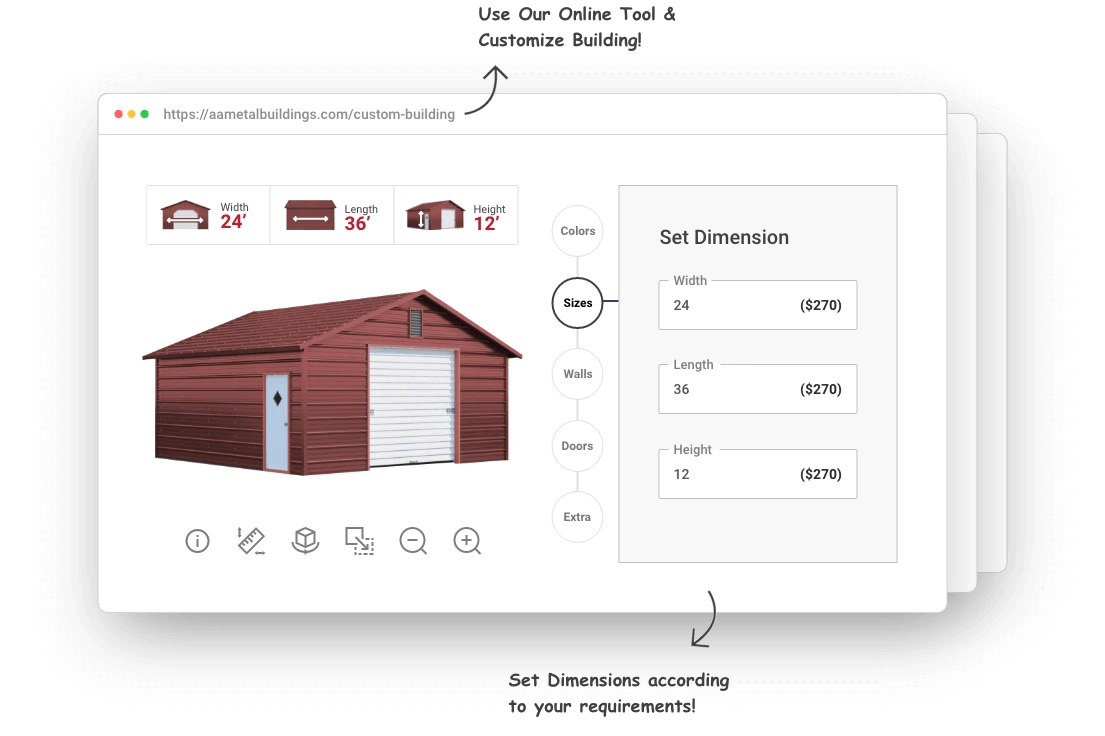
Call our building specialists directly. We’ll ask for your building size, intended use, ZIP code, and any specific requirements — and give you a fully itemized, ZIP-code-specific quote in minutes. No vague starting-at pricing, no hidden add-ons after you commit. You can also use our free 3D Design Tool online to configure your building and see real-time pricing before you call.
Get a Real, Itemized Quote From AA Metal Buildings
No starting-at pricing. No hidden add-ons. Just an honest, fully itemized quote based on your exact size, ZIP code, and requirements — delivered in minutes over the phone.
Or use our free 3D Design Tool to configure your building and see pricing online right now.