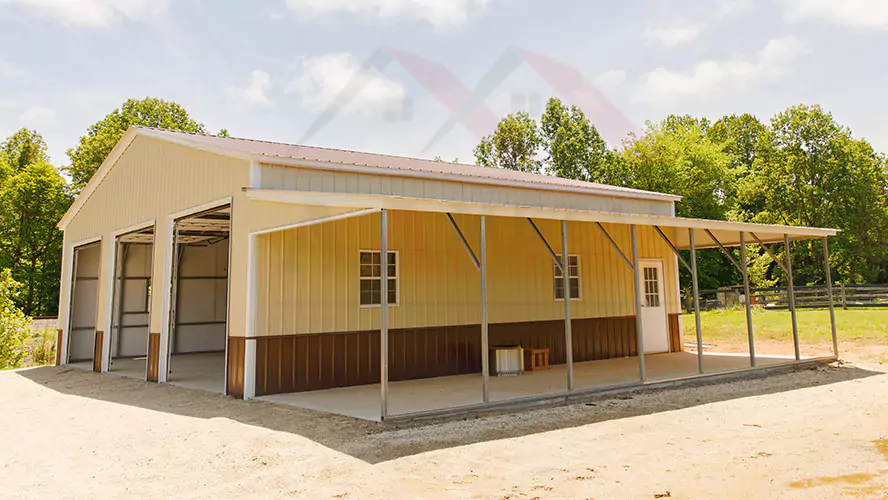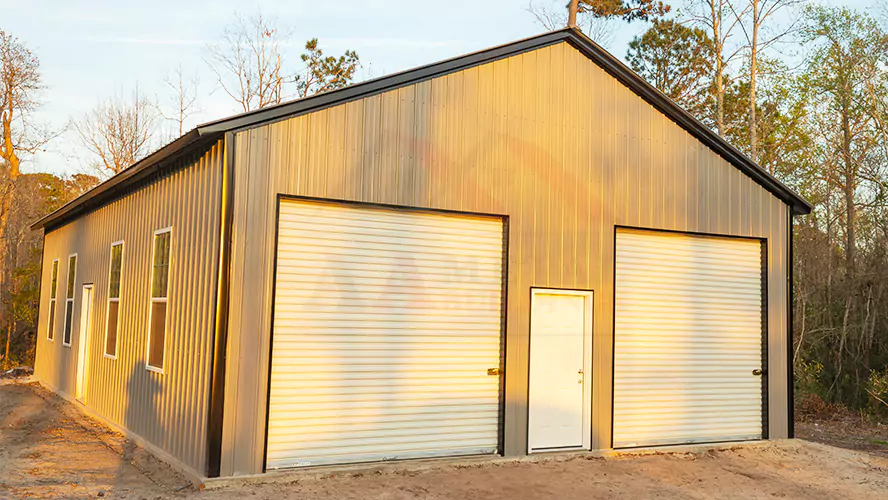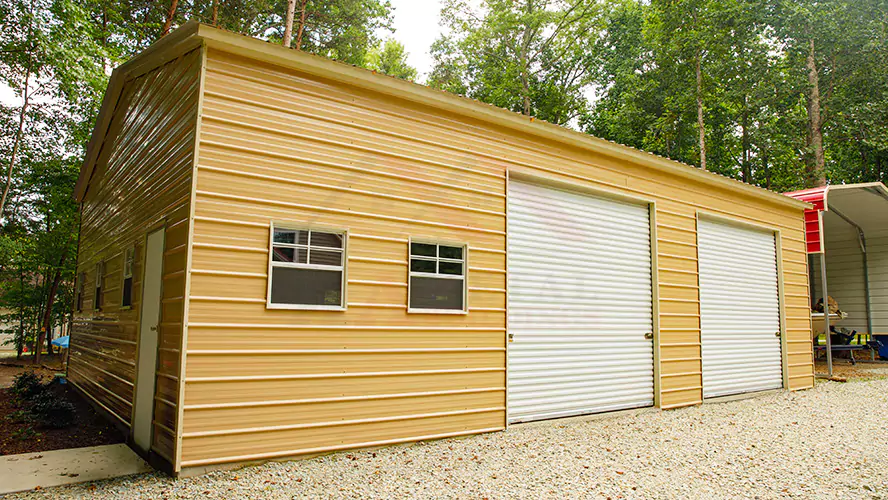



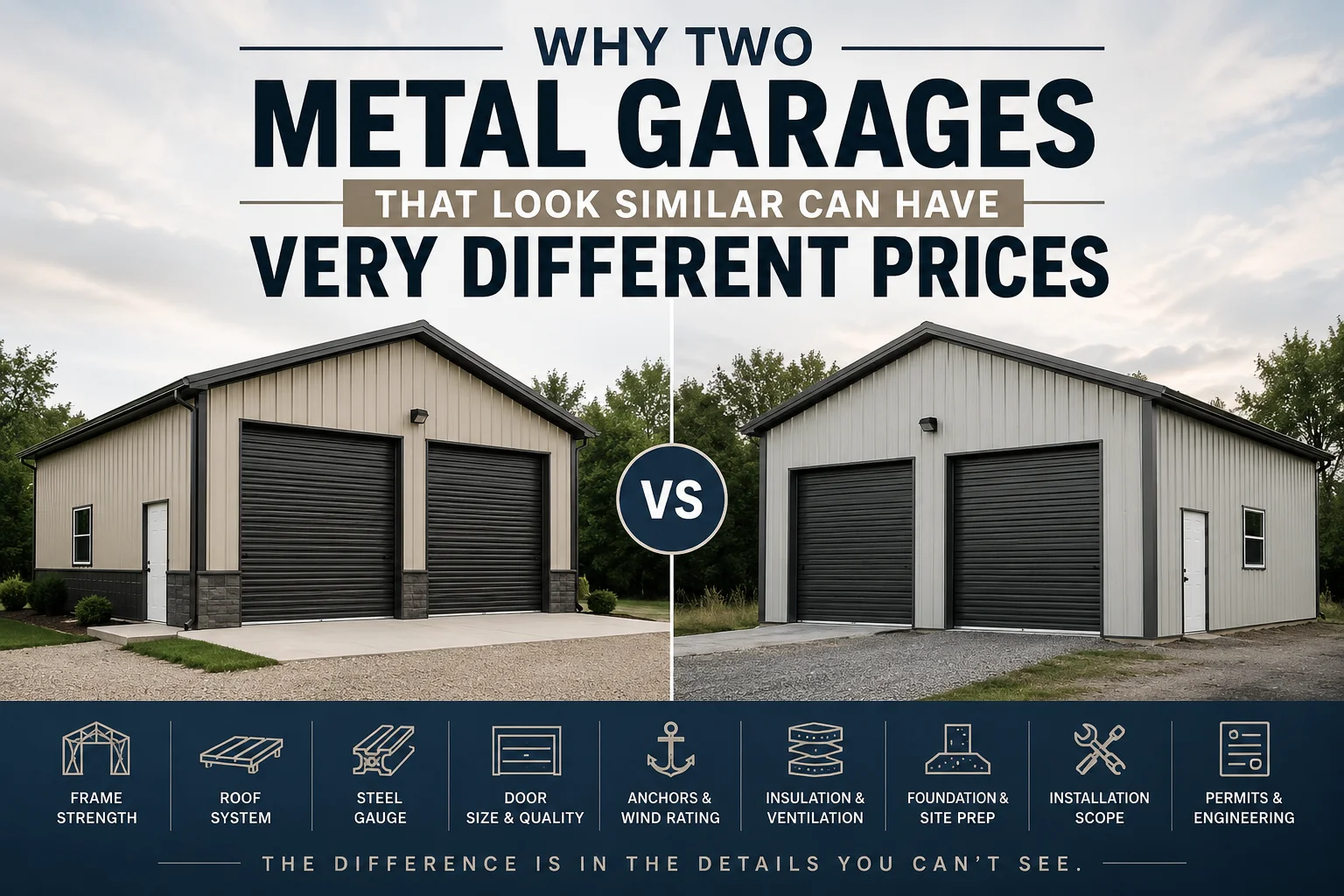
Two metal garages can look almost the same from the driveway and still be very different buildings. The price gap usually comes from the parts a buyer does not see right away: frame gauge, roof style, steel thickness, wind and snow ratings, anchors, door sizes, concrete, site prep, insulation, trim, permits, and what the installation crew is actually responsible for.
The cheaper quote is not a bad quote.
The higher quote is not the better one.
The real question is this: Are both quotes pricing the same building, on the same foundation, with the same installation responsibilities, and the same local code requirements?
That is where most price confusion starts.
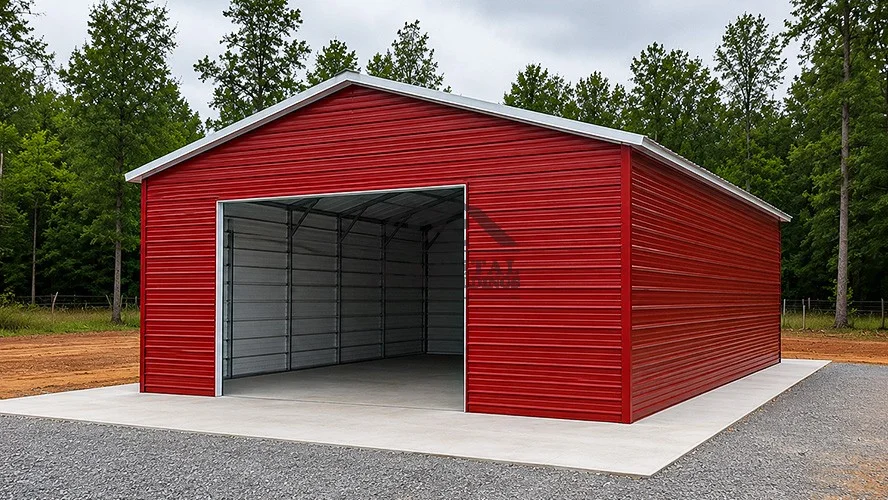
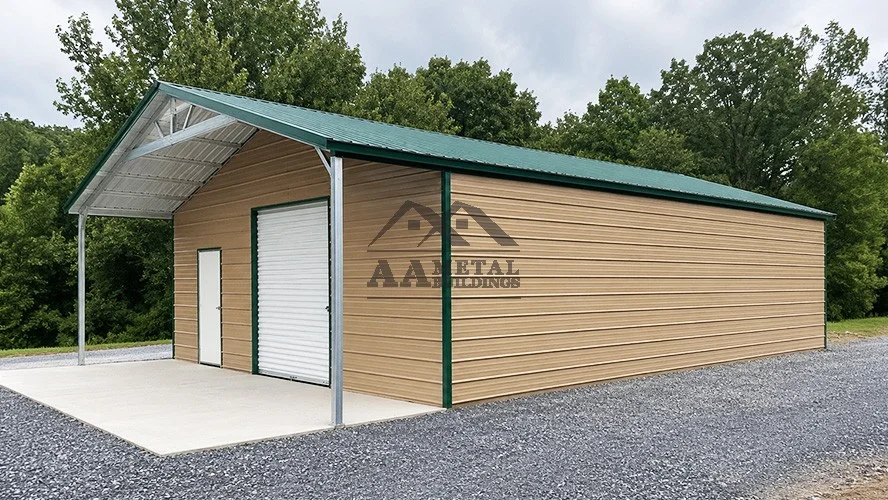
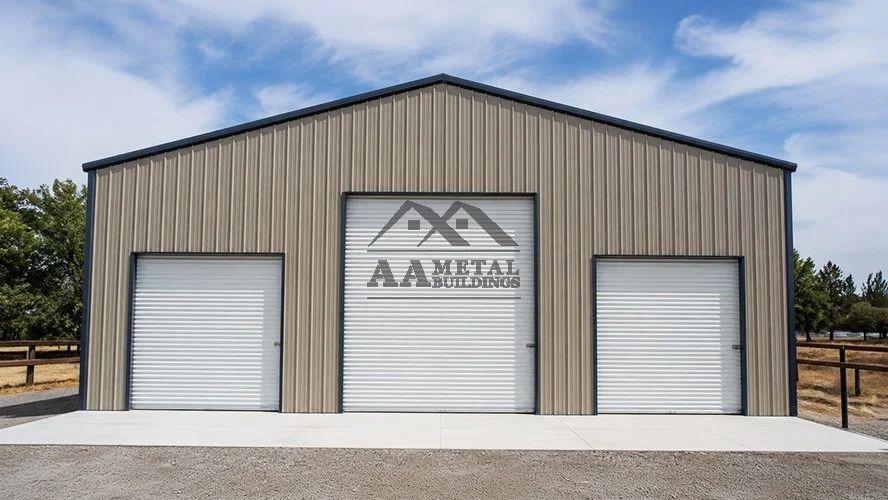
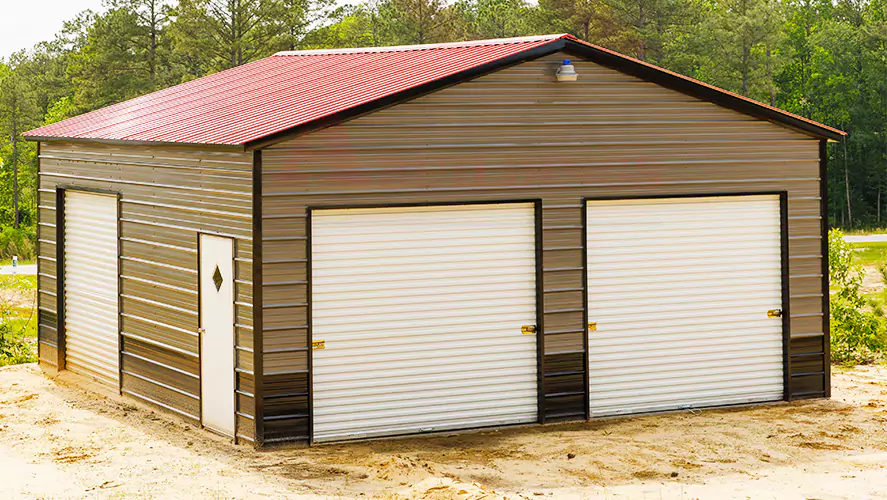
Two 24×30 metal garages can look nearly identical in a photo.
Same color.
Same roof shape.
Same two roll-up doors.
Same basic footprint.
Then one quote comes is higher.
Most buyers look at that and wonder, “Am I being overcharged, or is the cheaper garage missing something?”
That is the right question.
The price difference is usually not in the part of the garage you notice first. It is in the frame, roof system, steel gauge, anchors, door openings, certification, concrete assumptions, site conditions, insulation options, and installation details. Two metal garages can look alike on the outside and live very differently once they are on the property.
A Garage Quote Is More Than the Size on the Page
A lot of buyers start by comparing width, length, and height.
That is where the conversation starts, but it should not be where it ends.
A 24×30 steel garage with two doors is not always the same as another 24×30 steel garage with two doors. One may be a simple storage building meant for mild weather and basic use. The other may be built with heavier framing, a vertical roof, upgraded anchors, larger doors, certified wind ratings, and trim details that make it fit better beside a home.
Both can be called metal garages.
They are not the same garage.
That is why comparing only the final price can lead to a bad decision. You have to compare what the building is being asked to do.
The Frame Is Usually Where the Price Gap Starts
The frame is not the exciting part of a garage.
Nobody shows their neighbor the tubing size first. Nobody stands in the driveway and says, “Look at that bracing.”
But the frame is the part doing the work.
It holds the roof. It carries the panels. It keeps the building square. It handles wind pressure, roof load, door openings, and years of movement from weather and use.
A lighter-frame garage may be fine for simple storage in a protected area. A heavier-frame garage may make more sense on open land, in higher-wind areas, in snow country, or anywhere the building will be used hard.
That difference may not show in a front-view photo.
It shows up when a storm rolls across an open field. It shows up after several winters. It shows up when large door openings need proper support. It shows up when the owner expects the building to act less like a shed and more like a long-term garage.
A cheaper quote may be using a lighter frame.
That does not always make it wrong. It just means the buyer should know what is being priced.
Gauge Numbers Matter, But They Do Not Tell the Whole Story
Buyers hear terms like 12-gauge and 14-gauge and sometimes treat them like a simple good-versus-bad choice.
It is not that simple.
A garage used for a mower, garden tools, and holiday bins behind a house may not need the same frame as a taller garage storing a truck, trailer, side-by-side, and work equipment on open rural property.
The right gauge depends on the building size, roof style, door layout, local weather, and how the garage will actually be used.
Here is where people get into trouble: they compare two quotes without checking whether the same frame gauge is included.
The buildings look similar, so the prices feel unfair.
But one quote may be pricing a lighter-duty garage. The other may be pricing a stronger building with more steel in the parts you rarely see after installation.
That is not a small difference.
Roof Style Can Change the Price and the Way the Building Ages
Roof style is one of the biggest reasons two metal garages price differently.
A regular roof usually costs less. It has rounded edges and is often used on basic carports and simple garages. For some buyers in mild areas, it can do the job.
A boxed-eave roof has a more residential look. It often appeals to buyers who want the garage to look more like it belongs beside the house.
A vertical roof usually costs more.
There is a reason.
With a vertical roof, the panels run from the ridge down toward the eaves. That layout helps rain, leaves, and snow move off the roof more naturally. On longer garages, wooded properties, and areas with regular rain or snow, that can matter over time.
The cheaper roof may look acceptable on day one.
Three years later, the owner may care more about wet leaves, roof debris, snow movement, and maintenance than they did while comparing quotes.
A roof is not just a style choice.
It is a maintenance choice.
Door Size Can Make Two Similar Garages Very Different
Garage doors are one of the most common places where quotes stop matching.
Two garages may both have “two roll-up doors,” but that does not mean the doors are the same size, type, or framed the same way.
A 9-foot-wide door is not the same experience as a 10-foot-wide door. A standard-height opening is not the same as one planned for a lifted truck, work van, camper, tractor, or boat. A taller sidewall may be needed just to make the door size work correctly.
Door size affects price because it affects materials, framing, clearance, and installation.
It also affects daily frustration.
A truck that technically fits can still be annoying to park if the mirrors are close, the approach angle is tight, or shelving crowds the sidewall. Many owners do not regret buying a larger door. They regret buying the door that barely worked.
Barely works is not the same as works well.
Openings Remove Wall Space
Doors and windows look useful on a drawing.
They usually are.
But every opening takes away wall space.
That matters in a garage.
A wall with two windows and a walk-in door may look better from the outside, but inside that same wall may no longer hold shelves, a pegboard, a freezer, cabinets, a charging station, or a workbench.
This is one of the planning details first-time buyers miss.
The garage is not just a box. It is a working space with walls that will eventually hold things. Tools need a place. Ladders need a place. Oil, straps, extension cords, fishing gear, paint cans, feed bags, coolers, and storage bins all find a wall eventually.
A cheaper quote may include fewer openings.
A higher quote may include more doors and windows.
Neither is better. The question is whether the openings help the owner use the garage or quietly steal the best storage wall.
Height Is One of the Most Expensive Mistakes to Fix Later
Width and length get most of the attention.
Height causes some of the biggest regrets.
A buyer may measure the current vehicle and assume the garage is tall enough. Then a few years pass. The truck gets larger. A roof rack gets added. A camper comes into the picture. A boat needs winter storage. A contractor wants to park a work van inside.
The building that looked tall enough at purchase now feels limited.
A taller garage can cost more because it may require more steel, taller panels, larger doors, stronger framing, and different installation planning. But height is not easy to add later.
Paying for extra height upfront may feel unnecessary if you only look at today’s vehicle. It can feel very sensible when the garage is still useful five years later.
Certified Garages Often Look the Same but Are Not Built the Same
A certified metal garage is designed to meet specific wind or snow load requirements.
That sounds like paperwork until the county asks for it.
In many areas, especially places with stricter building departments, heavy snow, coastal weather, or open wind exposure, certification can affect the building design. It may require engineered drawings, stronger framing, specific anchors, bracing, or other structural changes.
A certified garage may not look much different in a photo.
The difference is in what the building is designed to handle and what documentation comes with it.
This is where the lowest quote can create problems. If a buyer orders a non-certified garage and later finds out the local office requires certification, the project can slow down. The building may need to be changed. The quote may need to be rebuilt. The permit process may have to start over.
The lower number was real.
It just was not the whole project.
Anchors Are Easy to Ignore Until the Weather Gets Bad
Anchors are small compared to the rest of the garage.
They are not small in importance.
The right anchor depends on the surface. Concrete, asphalt, gravel, and ground installations do not all use the same anchoring approach. A garage installed on a slab may need different anchors than one installed on a gravel pad.
Certification can also affect anchor requirements.
A basic anchoring package may be enough for some simple installations. A certified garage or exposed property may need a different setup.
This is not the place to guess.
Ask what anchors are included. Ask what surface they are intended for. Ask whether they match the building type, foundation, and local conditions.
A garage does not prove its anchoring on a calm afternoon.
It proves it when the weather turns.
The Foundation May Not Be in the Garage Price
Many buyers compare metal garage prices before they have settled the foundation.
That can make one quote look better than it really is.
A concrete slab usually costs more than a gravel base, but it changes how the garage can be used. Parking is cleaner. Rolling toolboxes move better. Floor jacks work better. Workbenches sit better. Stored items stay more protected from ground moisture when the slab and drainage are planned correctly.
A gravel base can work for certain storage uses, especially when drainage is handled well. But gravel is not the same as concrete for a garage that will be used for vehicles, tools, shop work, or long-term storage.
A mechanic trying to roll a jack across gravel learns that quickly.
A homeowner storing cardboard boxes near a damp edge learns it another way.
The foundation affects water, anchoring, door fit, pests, cleanliness, and everyday use. Even if it is not included in the metal building quote, it is part of the real cost.
Site Prep Can Change the Project More Than Buyers Expect
A level, open, easy-access site is one kind of job.
A sloped, tight, muddy, tree-lined, hard-to-reach site is another.
The garage may be the same size on paper, but installation is not the same experience. Crews need room to unload, stage material, move safely, and assemble the building. Low branches, fences, soft ground, narrow driveways, overhead wires, and uneven pads can all slow the job or create extra requirements.
Some buyers assume installation starts when the crew arrives.
Really, installation starts with the site being ready.
If the site is not level, accessible, and prepared for the type of foundation being used, the project can face delays or added costs. A lower quote that ignores site conditions may not stay lower for long.
“Installed” Does Not Always Mean the Same Thing
This is one of the most important parts of comparing metal garage quotes.
One company may include delivery, standard installation, basic anchors, trim, and cleanup. Another may include the building shell but leave out items the buyer assumed were covered. Concrete, grading, permits, insulation, electrical, drainage, and site work are often separate.
The word “installed” can hide a lot of differences.
A buyer should ask:
- Is delivery included?
- Are anchors included?
- What type of anchors?
- Is the site required to be level?
- Is concrete included or separate?
- Are permits included or handled by the owner?
- Are engineered drawings included if needed?
- What happens if the crew arrives and the site is not ready?
Those answers matter more than the sales price at the bottom of the page.
Local Codes Can Make the Same Garage Cost Different in Two Places
Metal buildings are affected by local rules.
A garage in one county may need very little paperwork. The same garage in another county may need setbacks checked, engineered drawings, wind ratings, snow ratings, inspections, foundation details, or fire separation from nearby structures.
This is why a neighbor’s price is not always a perfect comparison.
Their property may have different rules. Their building may be smaller. Their garage may be non-certified. Their site may have been easier. Their concrete may already have been poured. Their door layout may have been simpler.
Local requirements can turn a basic garage quote into a more specific building package.
That can raise the price, but it can also keep the project from running into trouble later.
Insulation Is Often Discussed Too Late
Many buyers think about insulation after the garage is already planned.
That is usually late.
If the garage will only hold a vehicle and a few outdoor items, insulation may not be a priority. But if the space will hold tools, paint, a freezer, equipment, business inventory, feed, hobby supplies, or anything sensitive to temperature swings and moisture, insulation and condensation control should be discussed early.
Bare metal buildings can sweat under the right conditions.
Warm air meets cool panels. Moisture forms. Stored items get damp. Tools start showing surface rust. Cardboard softens. The owner starts looking for fixes after the building is already up.
Planning for insulation early can affect the roof, walls, ventilation, doors, and budget.
It may not be visible from the outside, but it can change how comfortable and useful the garage feels through the year.
Trim and Finish Details Can Add Cost Without Changing the Footprint
Some price differences are tied to appearance.
Wainscot, extra trim, color combinations, enclosed gables, window placement, shutters, upgraded walk-in doors, and finished corners can all raise the price. These choices may be worth it, especially if the garage sits near the house or close to the road.
But they should be chosen on purpose.
A garage behind a barn may not need the same finish details as one placed beside a home. A building used for equipment storage may not need the same exterior treatment as a garage that becomes part of the property’s curb appeal.
There is nothing wrong with spending money on appearance.
Just do it after the structure, roof, doors, foundation, and code requirements are right.
Paint and trim cannot fix a garage that is too short, too narrow, poorly anchored, or hard to use.
The Cheapest Quote May Still Be the Right Quote
A lower-priced metal garage is not always wrong choice.
Sometimes the buyer has a simple need. A basic garage for mild weather, limited storage, and a prepared site may not require every upgrade available. Paying for features that do not change the owner’s use is not smart planning.
The problem is not the low price.
The problem is not knowing why the price is low.
A cheaper quote may be lower because the garage is smaller, lighter, non-certified, simpler, or missing items that will be handled separately. That can be fine if the buyer understands it.
It becomes a problem when the buyer thinks two quotes include the same thing.
The Higher Quote Is Not Always the Better One
A higher-priced are not always the best.
Some upgrades are useful. Some are unnecessary for the buyer’s property and use.
A homeowner storing one sedan and a mower in a mild climate may not need the same building as a ranch owner storing a tractor, trailer, tools, and feed in an open field. A small residential garage does not always need the same height, bracing, or door layout as a work garage.
Good planning is not about buying the most expensive steel garage.
It is about buying the garage that fits the site, the weather, the local rules, and the way the owner will actually use the space.
The Real Test Is How the Garage Works After It Fills Up
A garage feels largest before anything is inside it.
Then real life moves in.
A mower takes one side. Bicycles lean against the wall. Shelving goes up. A compressor lands near an outlet. Holiday bins stack in the back. A ladder needs a long wall. A freezer takes a corner. A pressure washer, generator, cooler, extension cords, spare lumber, and toolboxes all need a place.
That open floor plan gets smaller quickly.
This is why the lowest square-foot price can be misleading. A slightly wider garage, taller sidewall, larger door, or extra five feet of length may change the way the building works for years.
Owners rarely complain that they planned too much usable space.
They often complain that they planned only for the vehicle and forgot everything that comes with owning a home, land, equipment, or a hobby.
Think About the Garage Five Years From Now
Most buyers plan around what they own today.
That is understandable.
But garages have a way of collecting future needs.
A pickup replaces a smaller vehicle. A side-by-side appears. A boat needs winter storage. A teenage driver needs space. A home business starts. A hobby turns into a serious workshop. A ranch adds equipment. A contractor needs a dry place for tools.
The garage does not need to solve every future problem.
But it should not block the obvious ones.
A taller door, better roof, stronger frame, wider bay, or smarter walk-in door location may feel like an upgrade on quote day. Five years later, it may feel like the reason the building still works.
How to Compare Two Metal Garage Quotes Without Getting Misled
Start by ignoring the total for a minute.
Look at what is actually included.
Compare the width, length, sidewall height, roof style, frame gauge, panel gauge, door sizes, walk-in doors, windows, anchors, certification, trim, insulation, delivery, and installation scope.
Then compare the assumptions.
Is the site level?
Is concrete included?
Who handles permits?
Are engineered drawings needed?
What anchors are included?
Does the quote meet local wind and snow requirements?
Are there access issues on the property?
Is electrical separate?
Is insulation included or just available?
Once those details match, the price comparison becomes much clearer.
Before that, the cheaper quote may simply be pricing a different garage.
What AA Metal Buildings Wants Buyers to Notice
A good garage decision starts with use.
Not color.
Not only size.
Not the lowest payment.
Usecase.
Will the garage hold daily drivers? A truck? A mower? Tools? A boat? A camper? A workbench? A freezer? Seasonal bins? A side-by-side? Business equipment? Will someone work inside during winter? Will the building sit in an open field or beside the house? Will the county require drawings? Will the slab be ready?
Those answers explain the price better than any product photo.
Two metal garages can look similar and still be different in the ways that matter most.
The better choice is the one that fits the land, handles the weather, meets the rules, and still works after life fills it with vehicles, tools, storage, and the things nobody remembered to measure on day one.
Comparison Table
Why Similar Metal Garages Can Have Different Prices
| Price Factor | What Looks Similar | What May Actually Be Different |
|---|---|---|
| Size | Same width and length | Different sidewall height, clearance, or usable space |
| Frame | Same outside shape | Different gauge, spacing, bracing, or structural package |
| Roof | Similar roofline | Regular, boxed-eave, or vertical roof design |
| Doors | Same number of garage doors | Different width, height, framing, and hardware |
| Certification | Not visible from outside | Wind rating, snow rating, engineered drawings, or bracing |
| Anchors | Rarely shown in photos | Different anchors for concrete, ground, asphalt, or certification |
| Foundation | Garage shown on a flat pad | Concrete, gravel, grading, drainage, and slab prep may vary |
| Insulation | Hidden inside the building | Condensation control, wall insulation, roof insulation, and airflow |
| Installation | Both say “installed” | Delivery, anchors, site limits, permits, and exclusions may differ |
| Finish details | Same general color | Trim, wainscot, gables, windows, and walk-in doors may vary |
What to Check Before Choosing the Lower Quote
| If One Quote Is Cheaper | Ask This First |
| Lower base price | Is the roof style the same? |
| Lighter frame | Is the gauge right for your use and location? |
| Smaller doors | Will your current and future vehicles fit comfortably? |
| No certification listed | Will your county require wind or snow load documentation? |
| Basic anchors | Are they correct for your foundation and weather exposure? |
| No concrete included | What will the slab, gravel base, or site prep cost separately? |
| No insulation listed | Will moisture or temperature swings affect what you store? |
| Installed price | What does installation exclude? |
| No permit support | Who handles drawings, setbacks, and approvals? |
FAQ Section
Why do two metal garages with the same size have different prices?
Two metal garages with the same size can have different prices because the frame gauge, roof style, panel gauge, door sizes, anchors, certification, insulation, foundation needs, trim, and installation scope may not match. Width and length are only part of the quote.
Are steel garages more expensive if they are certified?
Certified steel garages usually cost more because they may need engineered drawings, specific anchors, added bracing, and wind or snow load ratings. The added cost depends on the building size and local requirements.
Is a vertical roof worth the extra cost on a metal garage?
A vertical roof is often worth considering for longer garages, rainy areas, snowy climates, and properties with trees nearby. The panel direction helps water, snow, and debris move off the roof more naturally.
Does frame gauge affect the price of metal garages?
Yes. Heavier frame gauge can increase the price of metal garages because more steel is used in the building. The right gauge depends on the building size, local weather, code requirements, and how the garage will be used.
Why do garage doors change the price so much?
Garage doors affect price because larger openings need more framing, hardware, clearance, and labor. Door width and height also affect how comfortable the garage is for trucks, vans, boats, tractors, and future vehicles.
Does a metal garage price include concrete?
Not always. Many metal garage prices do not include concrete, grading, drainage, or site prep. Buyers should confirm whether the foundation is included or priced separately.
Can a cheaper metal garage still be a good choice?
Yes. A cheaper metal garage can be a good choice when it fits the site, climate, use, and local code requirements. The buyer should make sure the lower quote is not missing anchors, certification, doors, concrete, or installation details.
What hidden costs should I watch for with steel garages?
Common hidden costs include concrete, site leveling, permits, engineered drawings, upgraded anchors, insulation, electrical work, drainage, larger doors, and local code upgrades.
What should I compare before choosing between two garage quotes?
Compare the exact size, height, roof style, frame gauge, panel gauge, door sizes, anchors, certification, insulation, delivery, installation scope, foundation requirements, permits, and exclusions.
Why does location affect metal building prices?
Location can affect metal building prices because local codes, wind ratings, snow loads, delivery distance, site access, and foundation requirements can vary from one property to another.